
In this article
- Understand the specific dynamics of a helicopter accident
- Before impact: prepare in the seconds available
- On impact: safety position and immediate reflexes
- A landing requires a preparation specific to the device
- The Most Common Mistakes
- And with vulnerable passengers on board?
- After the evacuation
- Simple preparation before a helicopter flight
- Protective position and exit from the helicopter
- Official sources and landmarks
The helicopter is a unique aircraft in the transportation landscape - its uses are often linked to demanding environments, its emergency configurations are radically different from those of a commercial aircraft, and its passengers are rarely prepared for what happens during an incident. It is precisely this combination that makes the preparation specifically useful here.
In Quebec, helicopters are omnipresent in a variety of contexts: medical evacuations in remote areas, monitoring of power lines, transport to forestry or mining yards, tourist flights, civil security patrols. In France, the helicopters of the civil security, the SAMU, the gendarmeries and the offshore oil industry are regular components of the aerial landscape. In all these cases, the passengers carried have rarely received specific helicopter survival training.
This guide covers the essential reflexes for a helicopter passenger – with particular attention to the two most demanding scenarios of this context: emergency landing on difficult terrain and turning in the water.
Workers on regular helicopter flights to offshore platforms or remote areas typically benefit from specific training – including Helicopter Underwater Escape Training (HUET). This guide is for occasional passengers who do not have access to these trainings but want to know the basic principles.
Understand the specific dynamics of a helicopter accident
A helicopter is not a plane with rotors instead of wings. Its mechanical characteristics, emergency configurations and specific risks are sufficiently different to warrant a separate analysis.
What distinguishes the helicopter from other aircraft
Autorotation - the helicopter's natural emergency landing
Contrary to popular belief, a helicopter whose engine fails does not crash vertically. The pilot can initiate an autorotation procedure - the rotor blades continue to rotate freely under the effect of upward air during descent, allowing a controlled landing. This procedure requires altitude and space - it is not always possible depending on the context of the breakdown.
Tendency to turn in water
Demanding operating environments
Helicopters frequently operate in environments where no other aircraft can land - mountain flanks, dense forest, arctic areas, offshore platforms. An accident in these environments combines the challenges of aerial incident with those of survival in hostile environments - extreme cold, inaccessible terrain, distance from rescue.
Restricted cabin configuration
The cabin of a helicopter is usually small, with little movement space, sliding or tilting side doors, and outside visibility that can be limited depending on the passenger’s position. In the event of a reversal, these spatial constraints complicate orientation and exit – especially under water in the dark.
Dominant risks depending on the context
The helicopter accident data identifies three main risk configurations: ground impact during a failed emergency landing or loss of control at low altitude, overturning in water during an emergency landing, and disorientation followed by a difficult exit during accidents at night or in conditions of reduced visibility. These three configurations call for distinct reflexes.
Before impact: prepare in the seconds available
An emergency landing in a helicopter rarely takes as long as an emergency landing in a commercial aircraft. The preparation window can be from a few seconds to a few minutes depending on the nature of the problem. These seconds have a disproportionate value if used effectively.
Immediate Preparation Actions
1. Identify the door opening mechanism
Helicopter doors vary greatly depending on the model - side sliding door, external tilting door, emergency ejection mechanism glass. Locate and mentally test the opening mechanism of the door before impact. In case of overturning in water, finding this mechanism in the dark and under hydrostatic pressure is infinitely more difficult without having spotted it in advance.
2. Tighten the belt and adopt the safety position
3. Locate a fixed reference point
In the event of a reversal in the water, the spatial orientation is immediately disturbed. Before any emergency landing, identify a fixed reference point in the cabin - a door handle, a window sill, the position of the pilot - and maintain contact with this tactile marker when turning over.
4. Remove glasses and secure sharp objects
Glasses, pens, rigid objects in chest pockets can cause serious injury during an impact or a reversal. Removing or securing them before impact takes a few seconds and avoids avoidable injuries. Do not remove the shoes - they protect the feet during evacuation on a field or in water.
On a flight over water : if a lifejacket is available on board, put it on before take-off or as soon as an emergency is announced - without inflating it. The swelling occurs only once outside the device. On professional offshore flights, the wearing of the vest upon boarding is generally mandatory.
On impact: safety position and immediate reflexes
The impact of a helicopter on the ground differs from an aircraft landing by its multidirectional nature - the aircraft can touch the ground sideways, tilt abruptly, or suffer several successive shocks if the rotor comes into contact with the ground or vegetation. The safety position shall be maintained until complete immobilization.
From immobilization - on the ground
Specific risk to the rotor : A helicopter rotor at the end of rotation may continue to rotate for several seconds after impact. It can also tilt during a device failover. Never straighten or exit from the top of a cabin without ensuring that the rotor is completely immobile.
A landing requires a preparation specific to the device
The exits, harnesses and device configuration determine the procedure. Ask the pilot to show the exits and their mechanism before the flight. Practical underwater exit training is particularly relevant for regular flights over water. A sequence read in an article does not replace it.
The Most Common Mistakes
Try to open the door during the turn
Inflate the vest inside the cabin
Same as the case of the aircraft - an inflated vest in a partially submerged cabin plates the passenger against the ceiling of the returned aircraft and prevents him from swimming towards the exit. This error is regularly identified in maritime helicopter post-accident investigations. The vest inflates only on the surface, once out.
Lose the fixed marker when flipping
Turning in water causes immediate spatial disorientation - up and down no longer correspond to the usual references, the darkness can be total. A passenger who has not identified a fixed marker before the rollover may be unable to locate the door in critical seconds after immobilization.
Straighten under the rotor after impact on the ground
A rotor at the end of rotation is silent but potentially still in motion. On sloping terrain, a helicopter can tilt after the initial impact, lowering the rotor to the ground. Straighten or exit through a top opening without checking the condition of the rotor exposes you to a serious risk.
Don't listen to the pilot's briefing
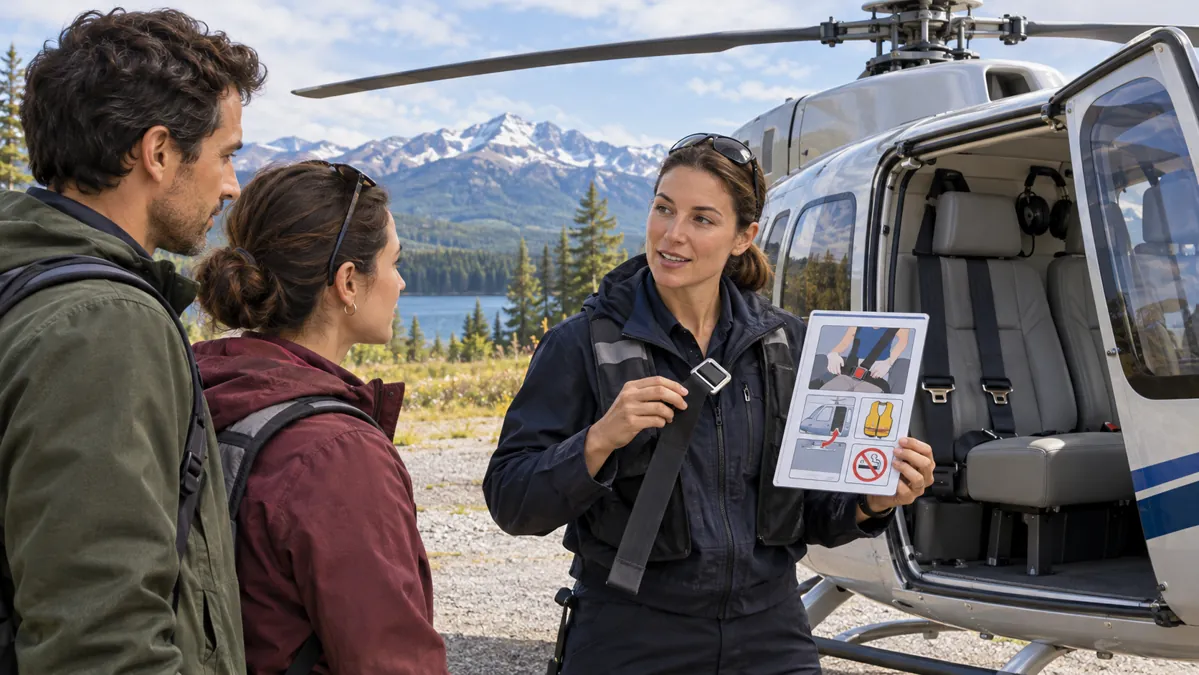
Helicopter pilots flying in isolated areas or over water systematically give a safety briefing before the flight - location of emergency exits, operation of emergency mechanisms, instructions specific to the aircraft. This briefing, often perceived as a formality by regular passengers, contains information specific to the helicopter model that is not included in this guide.
Leaving the area of the device in an isolated area
After an accident in the boreal forest, in the mountains or in the Arctic, the rugged aircraft remains the best reference for rescue and potential shelter. Leaving this area without adapted survival equipment and without a precise plan exposes to hypothermic risk in environments where intervention times can exceed several hours.
And with vulnerable passengers on board?
Helicopters regularly carry passengers with various profiles - medical evacuation patients, elderly people during tourist flights, children during discovery or emergency flights. These configurations require specific anticipation.
A passenger who is injured, unconscious or has limited mobility cannot independently follow the procedures described here. In a small helicopter with a single pilot, no other crew member is available to help. If another passenger is able to assist, their knowledge of emergency procedures can directly help someone who cannot act alone.
Before a helicopter flight with a child : Simply explain how the belt works, where the doors are, and that if something happens it stays attached and waits for the adult to tell him what to do. This simple framing reduces the panic reaction and keeps the child in a safe position longer than instinct alone.
After the evacuation
In aquatic environments - hypothermia and rafts
Once on the surface after a ditching, hypothermia is the priority threat in cold water - especially in Quebec waters where the temperature can be below 10 degrees C for much of the year. Go to a life raft if it has been deployed. In his absence, remain grouped with the other survivors - the collective body heat slows down hypothermia - and maintain eye contact with the wreckage of the aircraft that remains visible from the air.
Simple preparation before a helicopter flight
During the briefing and boarding
- Listen fully to the safety briefing of the driver or operator - it is specific to the device
- Identify and test the opening mechanism of its door before take-off
- Spot a fixed reference point that can be groped from its seat
- Locate the lifejacket if it is on board, and put it on for flights over water
Equipment and habits
- Inform a relative of the flight - operator, destination, expected arrival time - on any flight in an isolated area
- Wear clothing that is appropriate for the destination environment, not just at the start
- For workers flying regularly offshore or in isolated areas: ask the employer about available HUET training
Helicopter Underwater Escape Training (HUET)) : This one-day training, which is mandatory for offshore oil industry workers in many countries, includes practical pool flip exercises with equipment. It is also accessible to individuals making regular flights over water. Training centres are present in regions with high heliport activity - the Canadian east coast, the Gulf of Mexico and the North Sea. This is the most direct preparation investment for this specific scenario.
Protective position and exit from the helicopter
The harness and seat orientation change the position to adopt. Have it demonstrated by the crew and follow the aircraft sheet; do not automatically transpose the posture of an airliner. Keep the harness adjusted as directed and stay protected during movements.
On the ground, follow the pilot's instructions to exit and avoid the rotors. Do not pass backwards and do not assume that a silent rotor is stopped. In case of ditching, locate the exits and a fixed support before immersion; apply the procedure shown for your place. The vest inflates after exiting the aircraft, never in the cabin.
In an isolated area, get out of the danger of fire, fuel, and blades, and then stay in a spottable location near the site if that’s safe. Use available means of distress according to their instructions. A beacon or flight plan does not guarantee any transmission received or rapid arrival of rescues.