

A 52-week savings challenge offers an easy rule to understand: gradually increase the amount you put aside. Its simplicity does not mean that this pace suits every income. Before starting, check your household’s essential expenses and payment deadlines.
This plan appeals to many people who know they need to save, genuinely want to put money aside, and still have to deal with the realities of a tight budget.
Consider a household that wants to replace its freezer to organize food purchases more effectively. Having money set aside may allow it to pay for the purchase without finding the full amount at the last moment. This scenario follows the idea in the historical account; it does not describe a new personal purchase by the author or recommend buying a freezer. Energy, maintenance and food that will actually be eaten must also be considered.
The same financial margin may help cover an unexpected expense or certain needs during a disruption, depending on how much is available. However, distinguish savings for a planned purchase from money available for an emergency: assigning the same funds to both purposes would give a false sense of security.
Starting with one dollar is modest, but the deposits then increase to fifty-two dollars in a single week. If that progression becomes difficult, choose another method rather than borrowing to keep up with the challenge. The goal is a sustainable habit, without judging people who have no money available to save.
How does the 52-week savings plan work?
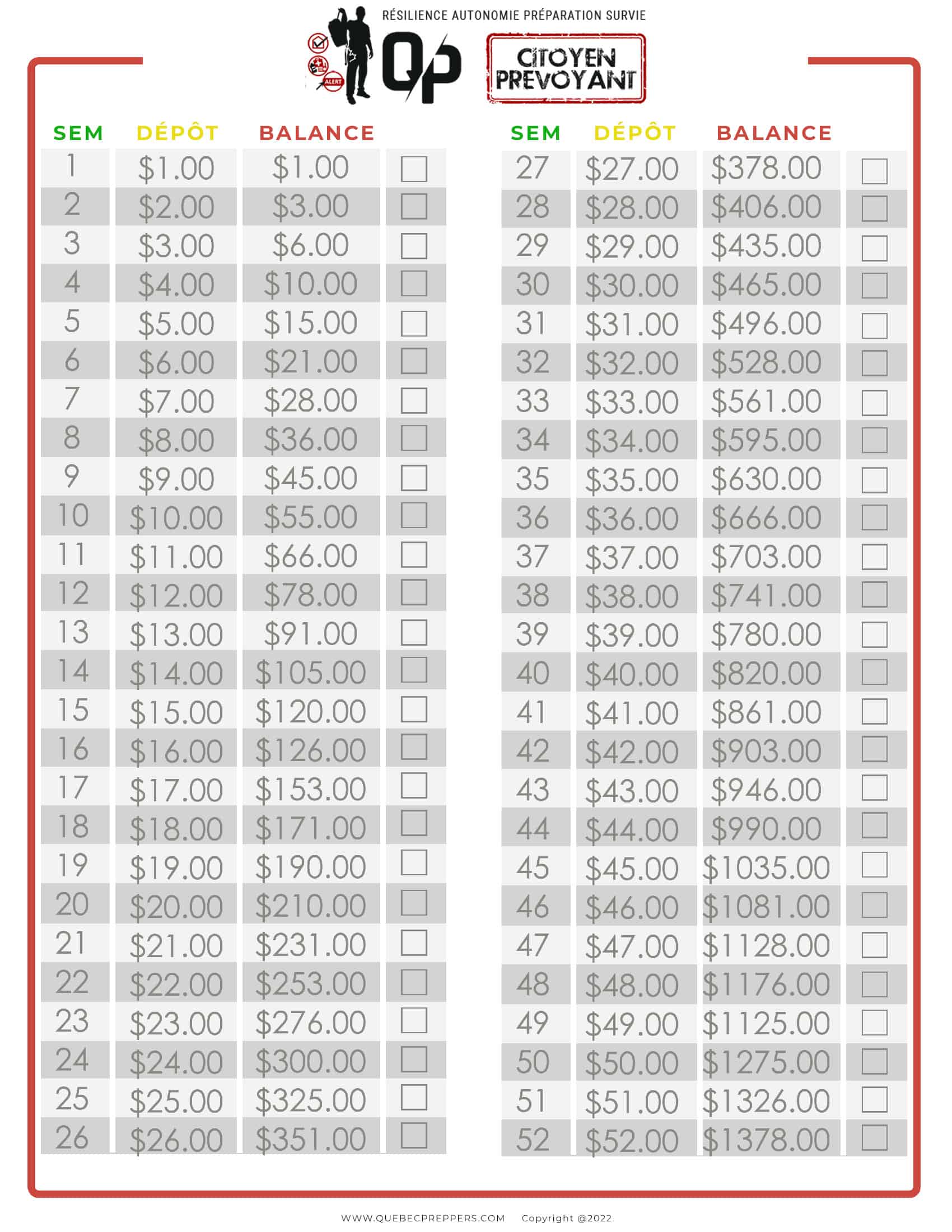
Most calendars number the weeks. The principle is simple:
Week 1: put aside $1.
Week 2: put aside $2.
Week 3: put aside $3.
Continue through week 52: $52.
After fifty-two deposits ranging from 1 to 52 dollars, the total is 1,378 dollars. The calculation is 52 × 53 ÷ 2; it does not include returns or possible fees. The challenge’s end date depends on when you start: it only falls in December if your chosen calendar makes it so.
If you have a surplus one week, you can add it to the savings pot. You will finish the year with more than expected or have created a useful financial cushion for more difficult periods.
The plan is also flexible:
Start with week 52 to put aside the larger amounts from January.
Adjust it to your current budget.
Set a specific starting date so that you do not keep putting it off.
Use a paper or digital chart and check off deposits you have actually made. You can track them in a notebook; no PDF needs to be created or replaced. If two people each complete the entire challenge, the arithmetic total is 2,756 dollars, provided their budgets allow it. Agree on contributions without placing an obligation on another person or a child.
Four tips for your savings challenge
1. Discuss a shared goal. A project, activity, purchase or donation can give the tracking process a purpose. Decide with the people involved what can be displayed and what should remain private. Children can learn to record small savings suited to their age, without becoming responsible for financing the household’s essential needs or contributing as much as adults.
2. Adapt the progression. Repeating weeks 1 through 26 twice produces a total of 702 dollars rather than 1,378. A fixed amount is another alternative: the classic challenge averages 26.50 dollars per week, but that average is not a minimum you have to reach. Choose a pace compatible with essential expenses and allow for a pause.
3. Begin with the larger amounts if appropriate. Reversing the weeks may be more practical for some households. This does not assume that January always leaves spare money after the holidays. Look at your actual payment deadlines, then choose an order that avoids difficult deposits; the total remains the same if all fifty-two amounts are deposited.
4. Examine planned purchases. Comparing package sizes and costs can free up money if a purchase is genuinely necessary. A promotion does not save money when it leads to an unnecessary expense or a quantity that will be wasted. The old promise of a monthly article about discounts is not presented as a current editorial schedule. Instead, record your own prices, consumption and needs before buying.
The challenge can support a habit, but it does not replace a budget or appropriate assistance with debt difficulties. Consult the Financial Consumer Agency of Canada’s guidance on an emergency fund. For a first attempt, record four weeks of deposits, withdrawals and reasons for adjustments. Using money for its intended purpose is not automatically a failure: what matters is its actual function, rather than completing a schedule at any cost.