
In this article
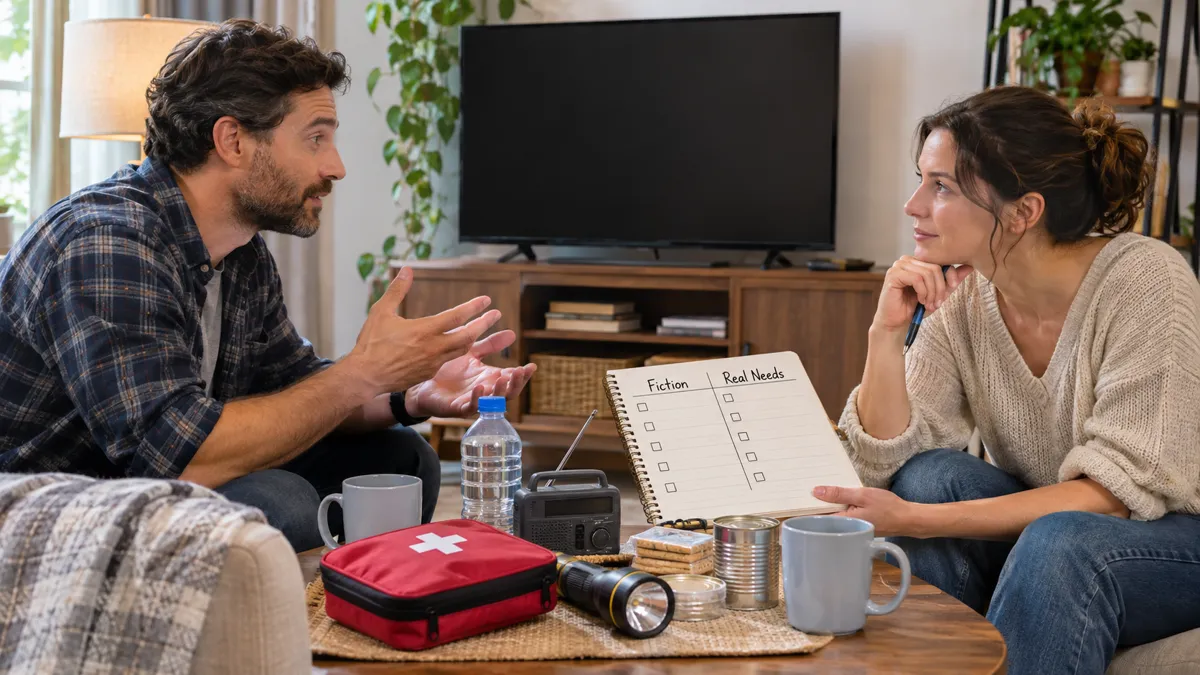
Homestead (2024) imagines the consequences of a disaster on a group gathered in an isolated property. Like all fiction, the film chooses events, accelerates certain tensions and leaves out a part of the real operation of the rescue. It can nevertheless serve as a starting point for a family discussion: what do we depend on and how would we organize if several services were interrupted?
The useful question is what needs to be covered in our own environment. In Montreal, as elsewhere in Quebec, the type of housing, cold weather, mobility, financial resources and neighbourhood change the answers.
1. Read the film as fiction
The film presented by its distributor Set up a shelter after a disaster. Its dramatic setting allows to explore the reception of other people, the management of resources and the tensions between individual and collective decisions. It is neither an operational model nor a forecast of the evolution of a failure.
After viewing, distinguish three levels: what the characters do, the consequences imagined by the authors and the measures you can actually prepare. Refusal to trust, use of force or isolation do not become solutions simply because they structure the plot.
Four questions can guide the exchange:
- What decisions could have been made before the disaster?
- Which people have needs that the group did not anticipate?
- How to check information when communications are disrupted?
- What limits should be placed on mutual aid without putting someone at risk?
2. Identifying its concrete dependencies
A breakdown does not affect all homes in the same way. An electrically heated home, a person using a medical device, and a family dependent on an elevator may have different priorities. Avoid starting from a general collapse: start with the function that would be missing in your home and the available solution.
| Function | Question to check | Possible preparation |
|---|---|---|
| Heating | When does the home become uncomfortable or unsafe for its occupants? | Clothing, reliable information and confirmed welcome in a heated place |
| Communication | Who to contact if Internet is unavailable? | Paper contacts, relay person and autonomous means of information |
| Food | What meals are possible without cooking? | Usual adapted reserve and manual can opener |
| Health and mobility | Which service or device cannot be interrupted? | Plan discussed with relevant professionals and accessible transport |
The level of disturbance and recovery time depends on the event. It cannot be inferred from a fiction that all grocery stores will be empty after a specific number of hours or that the authorities will be absent.
3. Do a winter exercise in an apartment
Imagine a power interruption in the evening. The accommodation remains safe for the moment, but the heating and some means of communication are disrupted. One person from the family is still outside. It is an exercise, without cutting a safety device or exposing a person to the cold.
- Find a lamp and essential coordinates without using the main lighting.
- Check where to get information from the provider and the municipality.
- Find out how to tell the person who is absent and who they can talk to.
- Prepare a meal without cooking with the food available.
- Identify the conditions that would lead you to ask for help or join a safe accommodation.
Discuss the difficulties observed: objects not found, outdated contacts, crowded exit or need for transport. Fix one gap at a time. The success of the exercise is measured by these concrete improvements.
4. Adapting equipment to housing constraints
Choose battery-operated or rechargeable lighting. A combustion appliance can produce carbon monoxide; a barbecue, camping stove or generator should not be used to heat an apartment. An improvised installation of candles and pots is not a safe heating solution. Follow the instructions of the authorized devices and the rules of your building.
The lack of heating is also prepared by a replacement destination. Confirm reception and transportation prior to the event, taking into account animals and mobility limitations. Municipal orders can direct to adapted reception places.
Reserves must remain stable, accessible and compatible with space and transport capabilities. Do not block exits, security equipment or technical access to gain storage. Gradually build up a supply of drinking water and food according to official recommendations and your needs.
A radio can complete the phone to receive information when local stations broadcast. An external battery helps keep some devices charged. Test sockets, cables, range and actual use; no single device guarantees access to all services.
5. Organize realistic mutual assistance
In a building, some agreements can be useful: check that a neighbor wants to be contacted, transmit messages from the manager and accompany a person to an accessible meeting point. Ask for people’s consent and avoid sharing their medical information or absences.
Plan who relays the information, how to confirm its origin, and what solution to use if the email group no longer works. Volunteers must not enter a prohibited area, intervene on an electrical installation or substitute for rescue.
Sharing requires understandable rules: what is offered, what must remain available for a health need and what everyone is really capable of doing. A promise too broad can put the group in trouble. Mutual aid must be able to adapt to the availability of its members.
Moving from discussion to decisions
At the end of the conversation, remember three feasible actions: complete contact information, prepare accessible lighting and confirm alternative accommodation. Enter a manager and a date, then check the result together.
To build this plan with local landmarks, consult the preparation at home in Quebec, Evacuation instructions and the Canadian advice for a breakdown. The film opens the discussion; your plan must meet the real conditions of your home.