
In this article
« I’m not ready until everything is bought” or “since I can’t predict everything, it’s useless”: these reasonings can slow down useful preparation. A progressive approach makes it possible to choose a realistic action, then to verify its effect. It takes into account the means, constraints and people who can help.
Find a conclusion too absolute
The language of all or nothing reduces a situation to two extremes: complete success or total failure. In the preparation of the home, it can mask abilities already present. A radio may be missing, but contacts can already be noted; the bag is not finished, but a destination can be confirmed.
This page offers a practical reflection. It does not make a diagnosis, does not describe an individual brain mechanism, and does not promise that a change in attitude will be enough to resolve a distress or material difficulty.
Trap 1: confusing preparation and equipment
A purchase fulfills a specific function. It does not make a journey safe on its own and does not replace learning or the communication plan. Before adding an object, ask what it should allow, who will use it and under what conditions.
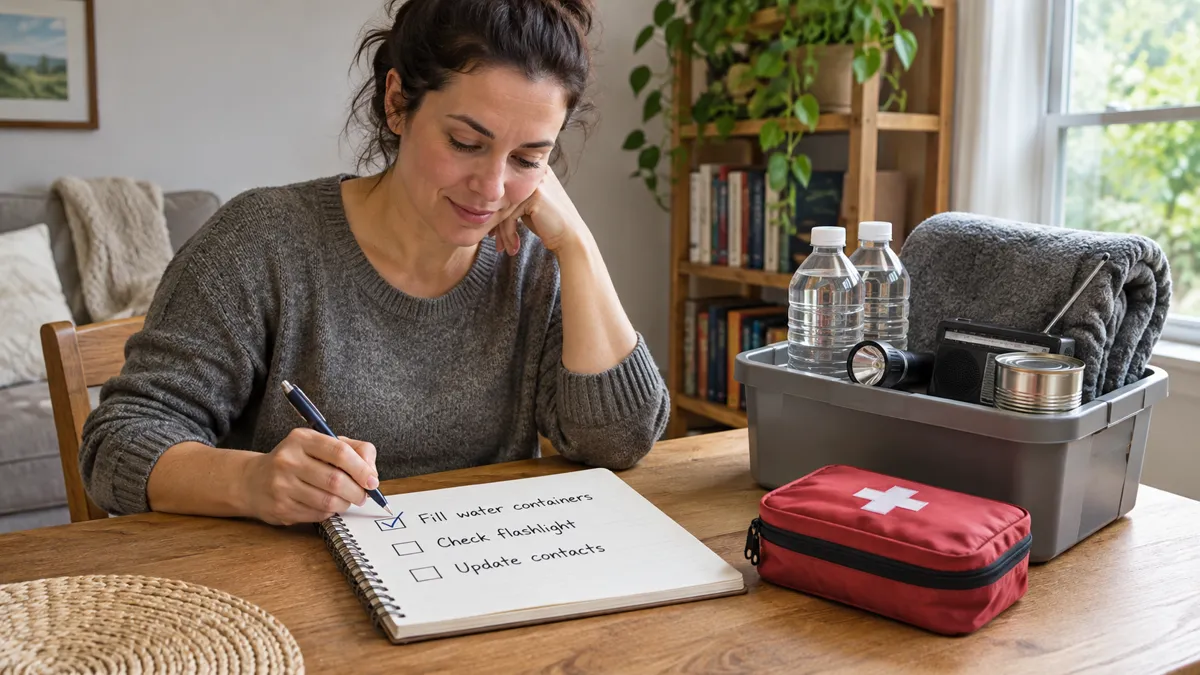
A list can be organized into three categories: what is already usable, what needs to be checked, and what is really missing. Try the available material first. A problem with access, batteries, weight or comprehension may be more important than the absence of a recent model.
Protective equipment or a weapon is not a guarantee of safety. Prevention, instructions, removal of a danger and remedies must remain at the forefront. An accumulation of objects should not exhaust the budget of current needs.
Trap 2: Turning difficulties into no solution
An increase in expenses, a breakdown or a loss of income can impose real constraints. Acknowledging them does not mean that the person lacks a positive attitude. Start with a defined need and a verifiable option: contact a service, confirm a relay, update a document or verify a device.
Reduce the size of the task if necessary. A short session may help to get started, but no fifteen-minute duration guarantees a boost of motivation. Schedule a break, help, or other time depending on the situation.
If a worry or feeling of helplessness becomes persistent and hurts on a daily basis, seek appropriate support. A checklist is not a treatment and does not replace the social services or resources a person may need.
Trap 3: think that experience dispenses with checking
An old practice, trade or equipment does not make a person competent in all areas. A neighbor can know access, a professional a technical constraint and a person accompanied his own need. Listening to this information improves the plan, provided that you check what requires specialized expertise.
A personal narrative does not validate a medical method, plant, electrical installation, or legal rule. Distinguish what the person has experienced, what they assume, and what a competent source confirms. Asking for a verification is compatible with the respect of his experience.
Transforming a general idea into the next action
- Name the need: receive an alert, access treatment, join a reception or maintain a meal.
- Describe the current state: resources, known limitations and missing information.
- Choose a feasible action: a call, limited trial, verification or storage.
- Provide a relay: Who can participate and within what limits?
- Check the result: Is the job actually done and for whom?
Write down the result rather than just a sense of preparation. A destination is confirmed when the person can receive you, not just when their address appears in a notebook.
Keeping room for learning
An error found during an essay can become useful information. Look for what has prevented action: confusing instructions, inaccessible material, forgotten need or false hypothesis. Correct one thing at a time and share the changes with the people involved.
Progress does not have to be spectacular. It can be to make a number readable, prepare a suitable garment or simplify a procedure. Value is measured by use, not by the number of purchases or comparison with another household.
Taking stock without judging
Use the PrépaCivile balance sheet as a reflection medium, then choose an improvement. A result does not predict the response to an emergency. The plan remains a work-sharing, reviewable and adapted to the circumstances.