
In this article
Introduction
Five checks make it possible to adapt your everyday equipment, often called EDC - Every Day Carry. The goal is to keep useful objects accessible and transportable, according to your real days.
- Identify the contingencies and tasks you are most likely to face.
- Choose objects that meet a specific need.
- Review the content and its transport over time.
Let's start!
What is an EDC kit?
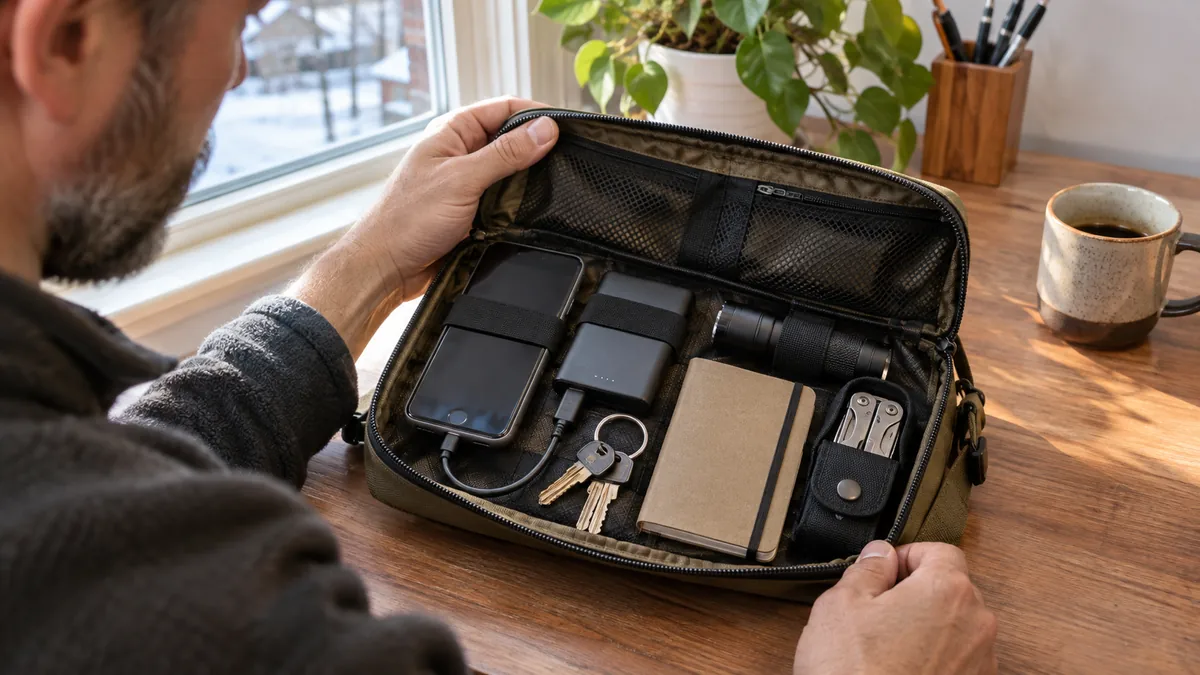
The EDC refers to the objects transported on a daily basis: keys, telephone, means of payment, glasses or other personal items. A thoughtful selection can also include a small lamp, rain protection or an external battery. The right content depends on your work, your journeys and your needs.
- Facilitate travel and a possible return to a safe destination, without guaranteeing it.
- Make life easier.
- Solve the common problems you face regularly.
- Reduce certain foreseeable difficulties, without presenting the equipment as universal protection.
- Give you peace of mind.
A basic EDC kit
There is no mandatory list suitable for everyone. Start with what you actually use and the plausible interruptions in your routine. The following five tips help to sort this out.
1. What needs and contingencies are most plausible?
Examine your journeys, schedules, weather, phone autonomy, and routine tasks. A transport failure, a walk after dark or a need for recharging can justify a specific object. A list seen on the Internet is not enough to make it useful for you. Classify needs before looking for products. Make up your everyday equipment →
Tip 2: What are you already wearing?
Empty your pockets and bag, then look at what’s present. Write down the necessary items, duplicates, broken items and those that no longer fit your situation.
- Check for unused keys and cards that you no longer see. Keep the documents and accesses you really need, without carrying an entire collection out of habit.
- A small, versatile tool can replace several objects, if its functions meet your tasks and if it is suitable for busy places. Compare its limits rather than buying just to multiply functions.
- A little used object can remain essential, such as a treatment or a means of alerting. First remove unnecessary duplicates; do not automatically remove anything that has not been used recently.
Choose useful functions before the brand or number of accessories.
Small lever: conditional use
For a small authorized repair, only if the need is identified. This lever does not replace a professional rescue tool and should not be used to force access. Offers may have different variations depending on the territory.

Stanley 55-045 Wonder Bar II Pry Bar II 19,5 cm
Visit on Amazon.ca — Stanley 55-045 Wonder Bar II Pry Bar II 19.5 cm
STANLEY FMHT1-55009 Arrache-Clous Gamme FATMAX - Pinces Biseautées - Acier Au Carbone - Tête Plate - Poignée Plastique - Finition Antiglisse Pour Un Meilleur Levier
View on Amazon.co.uk — STANLEY FMHT1-55009 Clamping Clamp FATMAX Range - Bevelled Pliers - Carbon Steel - Flat Head - Plastic Handle - Anti-Slip Finish for a Better LeverTip 3: What can you add to better meet these challenges?
Depending on the needs identified, a few categories can be considered:
- A tool suitable for small authorized tasks, only if you need it.
- A small lamp with autonomy and power adapted to your journeys.
- A reliable ordinary pen; no defense function is required to write.
Check the weight, size, maintenance and operating conditions of each item. The following accessories remain optional and must meet your context :
- First Aid Kit
- Phone or camera, depending on your usage.
- Equipment against rain
- Bottle of water
- Means of ignition only for intended and appropriate use; it is not a mandatory part of daily urban transport.
- Whistle of survival
- Compass
- Notepad
- A little cord, if you have a concrete use and know how to store it without risk of hanging.
Tip 4: How to carry your EDC kit
Once the selection is made, check how to wear it. Objects must remain accessible, without overload or inconvenience in transport. If the content is too bulky for your regular commute, review it instead of leaving it at home.
- A small kit, it should be able to fit in your pockets or purse.
- A medium-sized kit can be worn and organized into a shoulder bag or pouch.
- Many people carry larger kits in small backpacks.
If you decide to carry your kit in an EDC bag, be sure to choose one that will allow you to organize your equipment so that it is easy to find.
Tip 5: Review your kit regularly
Review content after a change of job, trip, season, or personal need. Also check the condition of the objects and the means of recharging.
- If you are facing a new challenge, you may want to add equipment to help him overcome.
- If a threat has changed, you may want to remove the hardware to lighten your kit.
You can choose a quarterly review or another pace that suits you. A check after use or change of situation remains useful between two appointments.
Conclusion
To build a sustainable selection, start from the needs, make the inventory, add only what is missing, test the transport and review the content. The complementary guides allow you to continue this reflection :
- Make your EDC list
- How to choose an EDC bag
- Choose a utility tool adapted to the tasks and places frequented.
- Choosing the Best EDC Flashlight
- Choose a simple and reliable way of writing.
A short, mastered list is easier to maintain than an accumulation of gadgets.
Sources and benchmarks
References for Quebec and Canada. Sources consulted on November 2, 2026.