
In this article
- Understanding the specific environment of the metro tunnel
- The first few minutes: evaluate before taking action
- Priority actions according to the situation
- The Most Common Mistakes
- And with children on board?
- After the evacuation
- Simple preparation before taking the metro
- Waiting for a supervised evacuation and reporting the danger
- In Montreal: Intercom First
- Official sources and landmarks
A subway between two stations in the darkness of a tunnel, with smoke starting to spread in the cars: this is one of the most anxiety-inducing scenarios that public transport users can imagine. And precisely because it is anxious, it is useful to have thought about it before being confronted with it.
This guide is intended for users of the Montreal Metro, the Paris Metro, and any French-speaking underground network. The principles are widely transferable from one network to another; certain technical specificities vary according to the operators.
The vast majority of subway incidents are resolved in minutes with a resumption of service or an orderly evacuation guided by staff. This guide deals with situations where this quick resolution is not possible – and where passenger decisions matter.
Understanding the specific environment of the metro tunnel
The subway tunnel has a combination of features that sets it apart from any other transportation environment. These characteristics directly determine the dominant risks and priorities for action.
The specific factors of the tunnel
Electrified rails at ground level
Rapid spread of smoke
A tunnel is a conduit. In the event of a fire, smoke spreads along the tunnel axis at a speed that may exceed that of a walker. The direction of propagation depends on the ventilation of the network, which can be oriented by the operators from the control stations. In the absence of information on this direction, visible smoke behaviour is the best indicator.
Obscurity and disorientation
A subway tunnel without active emergency lighting is practically in total darkness. Emergency lighting – mandatory in modern networks – does not guarantee sufficient visibility in the presence of smoke. Spatial disorientation is one of the most documented factors in underground incidents: without visual cues, the perception of direction and distance quickly becomes inaccurate.
Limited access for rescue
The configuration of Francophone networks
Montreal Metro (STM))
Paris Metro (RATP) and French networks
The first few minutes: evaluate before taking action
The majority of the prolonged fixed assets in the subway tunnel are resolved without evacuation. A technical incident, a malaise person, an object on the track - these situations lead to stops that last from a few minutes to about thirty minutes, managed by the staff without the intervention of the passengers. So the first question to ask is: is there an immediate threat that makes waiting dangerous?
The three-point evaluation rule : visible smoke or smell of burning? Abnormal heat in the car? Driver or staff evacuation instructions? If none of these three elements are present, the wait inside the car is generally safer than the personal evacuation initiative.
What operators do in an incident
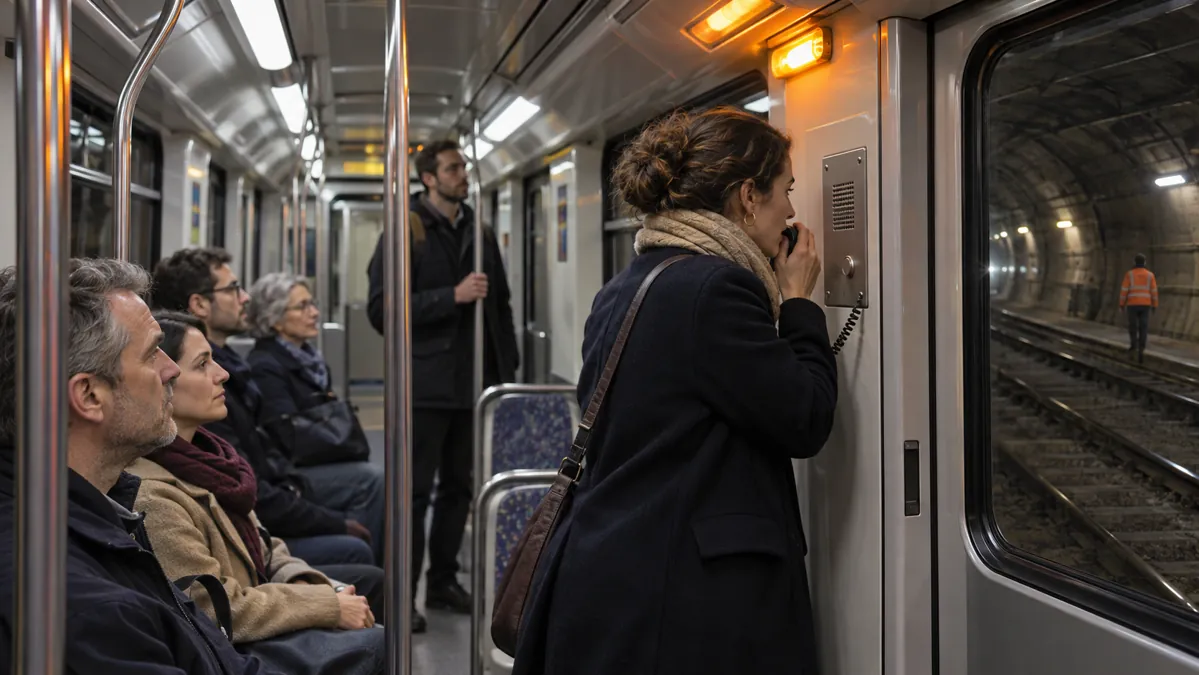
As soon as an incident is detected, the control stations of the network activate a standardized sequence: interruption of the electrical power supply of the section concerned, contact with the train driver, triggering of evacuation protocols if necessary, orientation of the rescue teams. This sequence takes time - and during this time, the driver communicates with the passengers via intercom. Listening to these communications is the first useful action.
As soon as prolonged immobilisation confirmed
1. Stay calm and observe
Panic spreads rapidly in a confined space. A passenger who maintains calm behaviour contributes to the collective stability of the car. Observe the situation: smoke? Heat? Conduct of the driver? Other passengers in trouble?
2. Listen to official communications
The driver communicates via the car’s intercom system. In some modern networks, visual messages appear on the car’s screens. These communications are the most reliable source of information - they take priority over rumours circulating between passengers.
3. Locate emergency exits
Without waiting for an evacuation to be decided, mentally identify the end doors of the car, the emergency windows and their opening mechanism. This preventive location avoids having to search in an emergency if the situation evolves quickly.
4. Report medical emergencies
If a passenger presents a medical emergency - malaise, difficulty breathing, injury - report it immediately to the driver via the emergency intercom available in each car. This information allows operators to prioritize and direct medical assistance.
Priority actions according to the situation
Immobilization without immediate threat - wait
If the car is immobilized but without smoke, abnormal heat and no evacuation instruction, staying in the car is the best option. The car offers a shelter, a recognizable structure for rescue, and avoids exposure to electrified rails. Use this time to assess the situation, locate exits and reassure nearby passengers who show signs of anxiety.
Orderly evacuation guided by staff
During a guided evacuation : follow the instructions of the staff without trying to go over the line or take a different direction. Staff are familiar with the tunnel configuration, rail condition and location of emergency equipment. Stay grouped and maintain a regular walking pace.
Presence of smoke - top priority
Smoke is the most urgent threat in a subway tunnel. Its toxicity and speed of propagation make it a danger that evolves in minutes, not hours.
- Lowering below the level of smoke - breathable air concentrates near the ground
- Go to the end door opposite the smoke source
- Use the phone lamp to maintain minimal visibility
Identifying the direction of smoke : the smoke moves in the direction of the tunnel ventilation. Observing its movement for a few seconds helps to identify the direction to avoid. Move perpendicular to its axis of propagation, towards a wall, then follow this wall towards the nearest station in the opposite direction.
Autonomous evacuation - last resort
A stand-alone evacuation – without staff instruction, by own initiative – is only justified if an immediate and obvious threat (dense smoke, visible fire in the car) makes waiting more dangerous than moving on the tracks. In this case :
The Most Common Mistakes
Get off the tracks without instruction
This is the most serious mistake in this context. A live power supply rail can cause fatal electrocution in contact or at close range. The power cut is only confirmed by the operators - not by the lack of visible visual indication. Never assume the rails are off without explicit confirmation.
Amplifying the collective panic
In a confined space with dozens of passengers, panic behavior – screaming, running, jostling – spreads rapidly and can generate injuries independent of the initial incident. Crash injuries during panicked evacuations in confined spaces are documented. Maintaining calm behavior is a direct contribution to collective security.
Using elevators in an incident
Separate from his group
In the darkness or smoke of a tunnel, separating from an accompanied person - child, elderly person, person with reduced mobility - can quickly become a critical situation. Maintain physical contact from the start of an evacuation, not just when visibility is reduced.
Blocking the evacuation doors
During an evacuation, blocking an end door to wait for a loved one left in the car can paralyze the evacuation flow of dozens of passengers. Give yourself a meeting point outside the car and move forward without blocking the passage - find the separated people once the evacuation is completed.
And with children on board?
The metro is one of the most used public transport with children in urban areas - school trips, family outings, daily commutes. A few specific points to anticipate.
From the beginning of prolonged immobilization, establish physical contact with the child and maintain a calm and factual communication. Children perceive and respond to adult anxiety – an adult who expresses uncontrollable worry amplifies the child’s distress. A simple and direct formulation is enough: “The train is stopped, the people who manage the metro take care of it, we stay together. »
Preparing the children in advance : during a subway ride, show emergency exit signs, explain where the driver is and what to call him. A child familiar with the subway environment – including its safety equipment – is less likely to panic during an unusual immobilization.
After the evacuation
Once out of the tunnel and at the station or on the surface, several priorities apply in the following minutes.
Physical and medical evaluation
Inhalation of even mild smoke can cause airway irritation, the effects of which can occur with a delay. If smoke exposure has occurred, report the duration and intensity of the exposure to the medical responders present. A persistent cough, burning sensation in the throat or breathing difficulties within hours of the incident warrant a medical consultation.
Post-Incident Stress Management
A confined space incident, even resolved without physical injury, can leave psychological traces - anxiety in public transport, avoidance of the subway, stress reactions to noise or darkness. These reactions are normal and usually resolve within a few days to a few weeks. Gradually resuming the metro, if possible accompanied at first, helps to overcome the avoidance reaction.
Information and reporting
Public transport operators systematically collect the testimonies of passengers after a significant incident. This information feeds into the improvement of emergency procedures. If malfunctions in the management of the incident have been observed - insufficient information, abnormal communication time, faulty equipment - reporting them to the operator contributes to improve safety for all users.
Simple preparation before taking the metro
Preparing for a subway incident is one of the simplest in this series – it requires no equipment and can fit naturally into daily commutes.
Entering the wagon
- Identify the communication intercom with the driver
- Spot the emergency door opening mechanism - usually a visible red lever
- Mentally note the direction of the nearest station in both directions
Useful equipment
- Charged phone - the lamp is useful in case of darkness, even if the network is missing in the tunnel
- Avoid Active Noise Cancelling Headphones on Long Tunnel Trips – They Hide Emergency Communications
The most useful habit : During any metro ride, look in which direction the arrow “emergency exit” closest to its seat points. This five-second observation, repeated with each trip, becomes an automatic reflex that can make a significant difference in case of darkness or smoke.
Waiting for a supervised evacuation and reporting the danger
Do not go down the path of your own initiative. One train stopped and the lack of lighting does not prove a power cut; another train can also run. The cables, rails and equipment must be considered dangerous until the intervention of the competent personnel.
During a framed evacuation, use only the exit and path indicated. The output side and direction depend on the network and the incident. Report a person from the outset who cannot follow; do not leave them without staff knowing their position. Keep the children close to you and clear the exits.
In Montreal: Intercom First
The STM recommends moving away from danger, using the intercom, describing the situation and following instructions. The emergency brake is reserved for immediate danger. At the station, use the reported assistive equipment; the red handle on the dock concerns a person on the track. Call 911 in case of immediate danger.