
In this article
Of course, we do not expect a world war to break out. Nevertheless, history and many analysts agree on one point: major conflicts frequently lead to civil disturbances (energy, food, medicines, materials, transport, communications).
Rather than suffer, I prefer to control what I can. : my personal preparations. As a Foreseeing Citizen in Quebec, I anticipate basic needs and now act to be ready to go through an unstable period – without panic, with method.
Objective : strengthen your bases (water, calories, health, information, finances, logistics) to last several days to several weeks in case of disturbances - without imagining the worst at every moment, but without naivety either.
Food
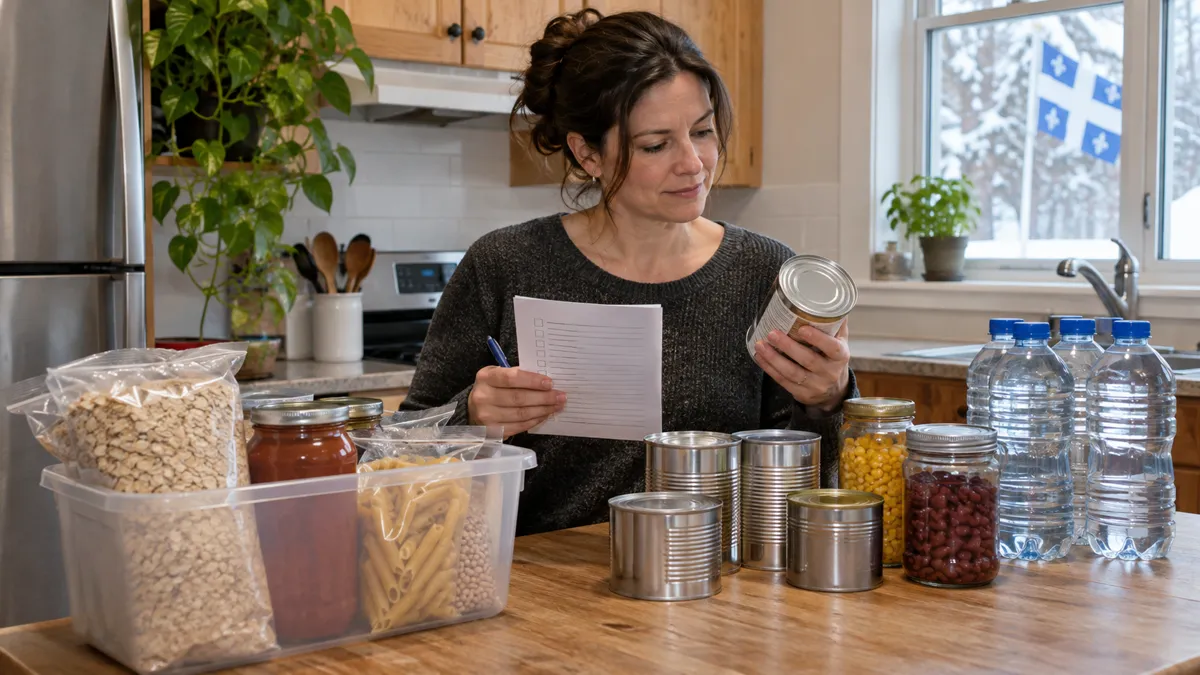
Let’s start with food stocks. During World War II, for example, daily consumption was rationed: Americans restricted access to food. food, shoes, metals, paper and rubber to give priority to the army. Even today, it is better to provide a stock of Non-perishable food (canned foods, rice, pasta, legumes, etc.) and’Water The official recommendations in Canada are clear: plan at least 2 L of water per person per day, No more dried or canned food.
Simple, efficient stock
- Canned vegetables, meats, soups)
- Rice, pasta, lentils, legumes
- Bouillon in cubes, energy bars
- Salt, sugar, oil (calories + preservatives))
The Golden Rule: Rotation I use what approaches the deadline and I replace as the races go on. The result: a living, useful stock, and much cheaper than “panic” purchases.
A house reserve (or bulk) is often cheaper than specialized kits, while offering variety.’Have enough calories and water to last several days (or more) if necessary.
Medicines and care
Prepare the continuity of treatments with the pharmacist and the professionals concerned: renewal, authorized quantity, storage and solution in case of interrupted access. A universal shelf life is not suitable for all products or people.
Consistent minimum to aim for :
- Prescribed treatments: quantity and renewal agreed with the professional, list of drugs and contacts accessible.
- Complete First Aid Kit — tapes, antiseptics, bandages, compresses, gloves, masks.
- Essential non-prescription medicines — analgesics, antipyretics, anti-allergics…
- Skills: tailored first aid training and a plan for access to care. Do not replace a treatment with a plant or improvised product.
Critical point often forgotten
Don’t just store equipment: store routines.
Check regularly the dates, the presence of items and the location (accessible, known to all). An untraceable or out-of-date kit is useless.
Security, Compliance and Regulated Assets
In times of crisis, some goods may become more difficult to obtain, due in part to supply chain tensions and government priorities. This sometimes includes regulated products.
Important: on PrépaCivile, the approach remains responsible and citizen. I do not participate in advice on acquiring or stockpiling dangerous or regulated goods. Focus on what really improves your safety: prevention, lighting, communications, health, neighborhood support, and compliance with current laws.
The most robust preparation is often the simplest: reduce your vulnerability (doors/locks, lighting, habits), maintain a margin of autonomy (water, food, health) and maintain a clear family plan.
Precious metals and savings
An emergency fund first targets unforeseen expenses and must remain accessible. Gold and silver do not replace available savings or accepted means of payment. Their value can fluctuate and their resale comes with costs and constraints.
Don’t present a precious metal as an assurance of purchasing power. Any investment decision depends on the financial situation and must be separated from the budget of the essential needs.
- Gradually build an accessible financial margin, adapted to the budget, and check the fees and conditions of access.
- Gradually build an accessible financial margin, adapted to the budget, and check the fees and conditions of access.
Communications and information
In a crisis situation, traditional communications (Internet, telephony, television) can break down. Not to be completely cut off from the world, the Amateur Radio can be useful: it allows you to send and receive messages without commercial infrastructure. On a larger scale, the Government of Canada has implemented the « On alert » which broadcasts important emergency messages on television, radio and mobile phones.
Local
Amateur Radio (HAM))
Obtaining the license and the basic equipment allows to have an exchange channel if the usual networks are disrupted. In general breakdown, relays of information can become valuable.
Official
The “ Alerting System »
This national service sends warnings on television, radio and mobile (extreme weather, evacuations, public warnings), without depending on the Internet.
Practical advice : plan a simple family communication plan (who to call, who to reach out of region, point of contact, standard messages) in case the networks are saturated.
- Amateur Radio (HAM)) : Get the license and the basic material.
- The “ Alerting System » : Keep alerts enabled on your devices.
- Emergency communication channel : establish a family emergency plan with fixed points of contact (neighbors, non-regional family) in case the networks are saturated.
Other practical preparations
Finally, I review various logistical details that can make the difference in a protracted crisis. :
- Health and hygiene : Resolve any outstanding medical or dental problems before the crisis (because services can be disrupted).
- Clothing and footwear : Warm clothing (coats, gloves, hats, boots) for each member of the family. Check that each child has strong shoes (sometimes provide +1 size).
- Automotive and fuel : tires in good condition, repairs not made, full of fuel as soon as possible; consider cooking/heating solutions adapted to your reality.
- Arrangement of the home : maintenance of critical systems (heating, etc.). Have flashlights, backup light and spare batteries.
- Essential documents : Emergency kit with copies of identity papers, insurance policies, emergency numbers and some cash.
These preparations do not claim to cover all the scenarios, but they form a Practical action plan to face a prolonged crisis: food, water, health, information, finance and logistics.
By adopting this approach, it is not claimed that a war is safe or imminent: it is simply a war. Caution and resilience. Ask yourself the right questions: Have you started building up an emergency reserve? What aspects of your life could you strengthen now to better stand up to the unexpected?
Frequently asked questions
What is the number 1 priority in case of major disruptions?
The bases : Water, Calories, Health and Reliable Information. Without these pillars, everything else becomes secondary.
How much water should be expected?
The official recommendations in Canada indicate at least 2 L per person per day, in addition to the water needed for certain tasks (cooking, hygiene).
How to avoid panic and impulsive purchases?
By building a progressive reserve: a little at each grocery store, with rotation. Calm, Methodical and Sustainable.
What is the best way to stay informed if the Internet falls?
Have alternatives: radio, official alerts, and a family communication plan (contacts outside the region, meeting points, standard messages).
Should there be a “financial reserve” of crisis?
Yes: A reasonable combination of accessible savings (and a little cash) can help get through the disruptions. Some also choose long-term assets, depending on their strategy.