
In this article
- A fictitious scenario to check dependencies
- Cascading contacts, with their agreement
- Meeting points are not automatic destinations
- Check the protocol of the school or childcare environment
- What a family card can contain
- Brief communication, without technical promise
- Talk to children according to their understanding
- Test by conversation, not by disappearance
- Official references
- Optional equipment examples
An emergency can occur while members of a household are at work, at school, on an appointment, or on the go. The contact plan is used to know who to contact, who can take over and what instructions to follow if the home or network is not accessible.
It must remain compatible with the procedures of the school, the childcare environment, the employer and the authorities. A family referral does not allow a child to leave a supervised place alone or automatically reach a meeting point through a dangerous area.
A fictitious scenario to check dependencies
Two adults are in different areas and one child is in school. Disruption of the transport delays the return; calls go wrong. This pedagogical case does not claim that a Tuesday at a given time would be the most likely time of a crisis.
The useful questions are concrete: does the school have the right contacts, is the adult relay allowed and available, and does everyone know what to do during the wait? The plan must provide for a change of destination without requiring children to manage adult decisions.
Cascading contacts, with their agreement
List the adults to contact and the order of contact that suits your situation. Each person must know the proposed role and accept it. Confirm its real possibilities: distance, transport, availability, health needs and the ability to accommodate or accompany.
A relative outside the area can serve as an information relay if communications allow. This is not a guarantee of connection. It is also necessary to provide that this loved one may be unavailable, change number or be affected by another difficulty.
Keep a copy of the contact information usable without the usual phone. Protect personal information and share only what is needed with the people who participate in the plan.
Meeting points are not automatic destinations
A gathering point after a fire in the home and a reception place for a prolonged evacuation do not have the same role. The first allows you to be at a distance from the immediate danger; the second must be accessible and able to accommodate the people concerned.
The home can be evacuated or dangerous. It should not remain the default point if the authorities ask to move away from it. An alternative destination must be known, but travel depends on the safety of the journey and updated instructions.
For a child under the responsibility of a school or childcare environment, the school’s procedures take precedence over a rule such as “if no one answers, go to the second point”. The child stays with the designated adults and follows the supervised evacuation, if any.
Check the protocol of the school or childcare environment
- What contacts and permissions should be saved and updated?
- Which adults can recover the child and what proofs are required?
- How does the facility notify families during a disruption?
- What is the reunification procedure if the building is evacuated?
- How are mobility, communication or health needs taken into account?
Ask the institution for this information rather than inventing a procedure. A trusted relationship or credit card does not automatically replace the required identification. Applicable custody arrangements and decisions must be respected.
In an emergency, avoid rushing to school without knowing the instructions. Access may be necessary to the rescue and the facility may ask families for a specific place or method of recovery.
What a family card can contain
| Public information | To be specified | To be updated |
|---|---|---|
| Responsible adults | Contact information and order. | Numbers, schedules and availability. |
| Relay persons | Accepted role and limits of aid. | Agreement, transport and authorizations. |
| Establishments | Official channels and reunification process. | Change of school, daycare or work. |
| Scheduled locations | Function, useful address and access to be confirmed. | Instructions, opening and risks of the journey. |
| Special needs | Information needed for the relay. | Consent, health and equipment required. |
The card does not need to tell all the scenarios. It must be readable, accessible to people who need it and understood. A digital copy alone may be insufficient when the device is unavailable; a paper copy also requires protection and updating.
Brief communication, without technical promise
Agree on a simple message: who writes, where the person is safe and what they plan to do next. Do not publicly share a child’s location or health information to facilitate family coordination.
Calls, SMS and apps have limitations. Signal or Telegram do not provide communication without a network by their installation alone. An app may need Internet and phone power; a message sent is not necessarily received or read immediately.
Exchanges with loved ones do not replace an emergency alert when there is an immediate danger. Use emergency means that are appropriate to the territory and situation; do not assume that all countries or services accept the same messages.
Talk to children according to their understanding
A short instruction can be useful: stay with the responsible adult, report a need and wait for the planned procedure. The content depends on the child’s abilities and the instructions of the institution, without the obligation to memorize a list of numbers at a fixed age.
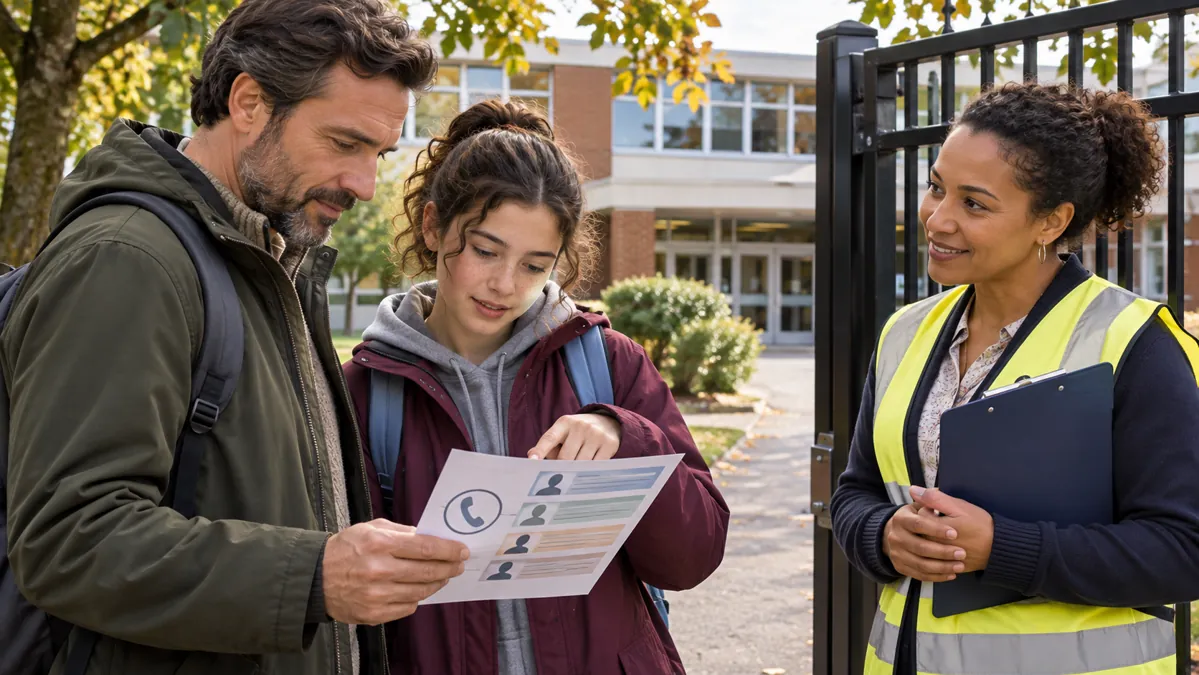
A child can review a file with an adult or ask a question. It should not be held responsible for the transportation, supervision of a younger or emotional safety of adults. Participation must remain appropriate, with no promise that it will eliminate any concerns.
You can recognize an uncertainty: “If I am delayed, the adults at the school remain responsible for you and use the planned contacts. » Avoid guaranteeing an arrival time that you do not know.
Test by conversation, not by disappearance
Announce a simple exercise: find a number, explain to whom to contact or verify that an adult relay has the necessary information. Keep normal supervision of the children and follow the procedures of the institutions.
Do not simulate disappearance, unsupported separation or real danger to provoke a reaction. It is not necessary to cut communications to discover that a number is missing on a record. Don’t call emergency lines to test the family plan.
After the exercise, write down the helpful correction and update the affected copies. Resume the plan during a change of situation rather than considering it as a final document.
Official references
Two items for putting these ideas into practice
Record roles, contacts and decisions, then plan charging for the phone used to communicate.
Affiliate links: as an Amazon Associate, PrépaCivile earns from qualifying purchases. These examples are optional. Check the model, package contents and terms. Use equipment you already own first.
Notebook for household information
Canada: three-pack; France: individual notebook. Compare size and quantity.
Canada — Amazon.ca
 Rite in the Rain Lot de 3 cahiers à spirale résistants aux intempéries, 7,6 x 12,7 cm, couverture noire, motif universel (n° 735-3)View on Amazon.ca
France — Amazon.fr
 Rite in the Rain toutes saisons carnet a spiral , 7,6 x 12,7 cm Étanche NoirView on Amazon.fr
Power bank for a compatible phone
Check connectors and cable. This is not backup power for a medical device.
 Anker Chargeur portable USB-C 10 000 mAh 30 W
 Anker Zolo Batterie externe 10000 mAh 30 W avec câble USB-C