
In this article
Emergency management systems in Quebec - municipalities, public safety services, relief agencies - generally work well. But they operate on a scale that cannot instantly cover all the needs of all citizens in all situations. At major events, there is typically a delay between when the emergency occurs and when professional resources become available for everyone.
An interruption of services may require an immediate organization of the home. The scope and timing of assistance varies depending on the situation. Don’t wait for a theoretical deadline to ask for help when a danger or urgent need arises.
Positioning of this article This article presents a specific program developed by PrépaCivile. This is not a formal directive or the only approach. Other resources exist (Canadian Red Cross, Ministère de la Sécurité publique du Québec, municipalities) that offer their own frameworks and tools. The 3P program is proposed as a complementary, non-exclusive option in the ecosystem of community preparedness resources.
The 3P Framework: Plan, Protect, Participate
Origin and development
The “Plan, Protect, Participate” framework is used here to classify the actions of the home and the neighborhood. This is not an official directive or certification. Its three axes can be used with existing public tools, adapting them to real needs and resources.
The objective was to create a simple, memorable framework applicable to the specific Quebec context - climate, geographic, cultural and institutional.
The three phases of the framework
Phase 1: Plan
Principle: Understand the risks of its specific context and plan accordingly. Components of this phase:
- Identification of local risks: What are the likely events in my area? (floods, ice, power outages, forest fires by geographic area)
- Assessment of Personal Vulnerabilities: Who in my home needs special attention? (young children, the elderly, medical conditions, animals)
- Family planning: Communication plan (how to reach each if separated), meeting points, emergency contacts
- Basic material preparation: 72-hour kit, accessible important documents, medicines, supplies
- Knowledge of local resources: Where is a municipal emergency shelter located? What are local emergency numbers? Who are the contacts in the neighbourhood?
Distinction with official systems: This phase completes (does not replace) municipal emergency plans. Citizens plan for their immediate needs during the period when professional services are solicited or inaccessible. Municipalities plan large-scale coordination and deployment of collective resources.
Phase 2: Protect
Principle: Know how to react effectively during the event to protect oneself and others. Components of this phase:
- Basic First Aid Skills: Ability to respond to common medical emergencies while waiting for professionals
- Management of specific emergency situations: What to do during flooding, fire, evacuation? Sequences of appropriate actions
- Effective communication: How to alert emergency services with clear information? How to communicate with family and neighbors?
- Decision making under pressure: When to evacuate vs stay in place? When to call 911 vs manage yourself?
- Immediate mutual support: Check out vulnerable neighbors, share critical resources so safe
Clear limits: This phase does NOT involve citizens becoming professional first responders or replacing emergency services. It aims for the ability to respond immediately in the interval before the arrival of professionals, and only within the limits of its skills and safety. "“Protecting” begins with not becoming an additional victim yourself.
Phase 3: Participate
Principle: Contribute to recovery and collective resilience after the event. Components of this phase:
- Personal and family recovery: Progressive return to normal, trauma treatment, post-disaster administrative management
- Community Support: Offer help to neighbors still in difficulty (according to own abilities), participate in collective cleanings
- Constructive feedback: Share experience with authorities to improve future plans
- Building resilience: Identify lessons learned, adjust preparation for next time
- Maintaining the social fabric: Difficult events can strengthen or weaken community ties - active participation fosters the first
Coordination with official structures: This phase is part of (does not compete with) formal recovery efforts. Municipalities, provincial and federal agencies coordinate large-scale recovery (infrastructure, services, financial assistance). Citizen participation complements these efforts at the micro-local and social level.
The 3P framework as a mental structure The main purpose of the 3P framework is not to invent new concepts - foreseeing, protecting and participating are principles already present in the emergency management literature. Its value is in the memorable simplicity that helps citizens to mentally structure their approach. "What do I do to plan? To protect? To participate?" becomes an accessible analysis grid to organize its preparation.
The concept of Community Resilience Citizen Network (CRCN)
Origin of the concept
A network of neighbours can arrange contacts and limited mutual assistance. It is neither an official rescue team nor a certification; its operation must be agreed with the persons and authorities concerned.
- CERT (Community Emergency Response Teams) - United States : Citizen teams trained for basic disaster response
- Resilient Neighbourhood Committees - Various : Citizen organizations focused on local preparedness and response
- Participatory models of emergency management: Approaches that recognize citizens as actors, not only beneficiaries, of emergency management
Proposed structure of the CRCR
The CPR is not a formal or bureaucratic structure; it is a flexible framework for local citizen organizations. Suggested components:
- Coordination Core: 3-5 volunteers in a neighborhood or area who initiate and maintain a network
- Identify, with their consent, the people who want contact or help and the means available. Do not share health information in a neighbourhood group.
- Established communication: Contact list, communication group (WhatsApp, Facebook, etc.), protocol for alerts
- Periodic meetings: Maintenance of the social network, updating information, organization of activities preparation
- Liaison with the municipality: The RCRC informs the municipality of its existence and coordinates with (does not replace) official structures
Typical activities of an RCRC:
- Organization of community preparation workshops
- Small scale simulation exercises
- Mutual verification during weather alerts
- Sharing information on local resources
- Mutual support during and after events (depending on capacity and safety)
Institutional positioning
Crucially, the CRCR does not compete with or replace formal emergency management structures. Relationship with Municipal Civil Security Organization:
- The RCRC operates at the micro-local level (street, sector of a few streets)
- The municipality operates at the macro level (whole city, coordination with emergency services)
- The RCRC acts in the interval before full municipal deployment
- The RCRC informs the municipality of its activities and complies with official guidelines during emergencies
Relationship with First Responders:
- RCRC never replaces professional services (firefighters, police, paramedics)
- It can facilitate their work by having citizens already organized and informed
- It can quickly identify vulnerable people requiring priority attention
- He never takes actions that would hinder professional intervention.
The RCRC as a structured social network Basically, the CRCR slightly formalizes what often spontaneously emerges during disasters: neighbours helping each other. The difference is that this mutual assistance is anticipated, organized preventively, and integrated with (not opposed to) official structures. It is deliberately cultivated social capital.
Limitations and Challenges of the RCRC Model
Honesty needed on the challenges of this model:
- Voluntary commitment: Requires people willing to invest time and energy - difficult in communities where all are already overloaded
- Long term maintenance: Easy to launch, difficult to maintain for years without an event - motivation declines
- Diversity and Inclusion: Risk that certain groups (age, language, culture) are under-represented if conscious effort of inclusion is not made
- Coordination with authorities: Requires municipality to be responsive and recognize network value - not guaranteed everywhere
- Legal responsibility: Questions about liability if self-help actions cause damage - requires clarification with assurances and authorities
- Not universal: Works better in some types of communities (stable residential) than others (hyper-mobile urban)
These challenges do not make the model invalid, but they do require honest recognition and local adaptation.
Implementation: from concept to practice
For individuals and families
The use of the 3P framework and grid does not require participation in a formal network. Suggested Steps for Individual/Family Use:
- Gather the official instructions useful in the home and identify the tasks to be organized in each of the three axes.
- Completing basic family emergency plan - 30-60 minute exercise
- Evaluate current emergency kit, identify priority gaps
- Approaching topic with family (especially children) to familiarize without anxiety
- Review annually (contacts change, needs evolve)
This individual approach already offers substantial value even without a Community dimension.
For groups and organizations
An institution may use this discussion grid in addition to its own procedures. Managers must validate adaptations and compliance with their obligations before an exercise or activity.
- Integration into curriculum (science, citizen education)
- Simulation exercises adapted to the age
- Involvement of parents via emergency family plan
Residences for seniors:
- Adapting to mobility and specific needs
- Identification of contact persons
- Coordination with institutional emergency plan
Workplaces:
- Supplement to existing health and safety plans
- Employee Accountability
- Continuity of operations
For Communities (RCRC launch)
If citizens want to organize an RCRC in their neighborhood: Suggested Steps:
- Evaluate interest: Probing a few neighbours - is there receptivity?
- Initial meeting: 5-10 people interested, concept presentation, core identification coordination
- Identify, with their consent, the people who want contact or help and the means available. Do not share health information in a neighbourhood group.
- Establishment communication: Contacts list, WhatsApp/Facebook group, etc.
- Liaison municipality: Inform municipal civil security organization, get their perspective
- Initial activity: Small workshop or simple exercise to create cohesion
- Maintenance: Quarterly or semi-annual meetings, update information
Realism on scale: An effective CPR can cover as little as a street or an area of a few streets (50-200 people). The micro scale is an advantage, not a limitation - authentic connections are easier to maintain.
Limitations and recognition of uncertainty
What this program cannot do
Honesty needed on the limits of the 3P framework and related tools:
- Does not replace professional systems: Comprehensive community preparedness does not eliminate the need for professional emergency services, municipal plans, official coordination
- Does not guarantee absolute security: No preparation can eliminate all risks - some events exceed any citizen or even institutional capacity
- Does not resolve structural inequalities: Some vulnerabilities (poverty, social isolation, severe disabilities) require systemic interventions, not only individual preparation
- Requires ongoing commitment: The preparation is not unique action - it requires maintenance, updating, practical. Many start but few maintain
- Not suitable for all contexts: Some populations (itinerant, institutionalized, highly isolated communities) require different approaches.
Unresolved issues
Several questions remain open regarding preparedness organization:
- Legal responsibility: If a citizen trained in first aid intervenes and causes unintentional damage, what protection exists? Do Good Samaritan Laws Cover Organized Actions?
- Formal Coordination: How to institutionalize the relationship between RCRC and municipalities without overbureaucratizing?
- Equity of access: How to ensure that preparedness resources reach the most vulnerable populations, not only the already resilient middle classes?
- Long term maintenance: How can we support citizen engagement for years/decades without major events that remind us of importance?
- Measure of effectiveness: How to assess if community preparedness programs actually improve resilience vs. creating only illusions of control?
These questions are not reasons to give up, but areas requiring continuous reflection and adaptation.
Conclusion: one tool among others
The Plan-Protect-Participate program and the tools that accompany it are proposed as a complementary resource in the ecosystem of preparedness in Quebec. They are neither the only possible nor necessarily the best approach for all contexts. What potentially distinguishes this approach:
- Simple and memorable framework (3P) that mentally structures the preparation
- Detailed practical tools rather than general principles alone
- Explicit Community Dimension (ECD) in addition to individual preparation
- Developed specifically for Quebec context
- A reflection grid that can be used without registration: predicting needs, protecting people and organizing safe participation.
What remains essential regardless of the approach chosen:
- Understand the risks of your specific context
- Have minimal plan and basic resources
- Maintaining social connections - resilience is collective as well as individual
- Coordinate with (not substitute for) official structures
- Recognize the limits of what preparedness can accomplish
Climate events and other emergencies in Quebec will continue to occur. Institutional systems will continue to respond with available resources. And in the interval between emergency and complete response, it is the citizens – prepared or not, organized or improvised – who constitute the first line. The objective of the 3P programme is to provide tools for this first line of citizens to be slightly more prepared, slightly more organised, and slightly more efficient - while remaining in its complementary role to professional systems. If these tools even partially serve this purpose for a few families or communities, they will have fulfilled their function.
Do you already use a structured framework for your family or community preparation? Does the 3P framework resonate with your context, or do other approaches seem more appropriate to you? The exchange of practical experiences helps everyone to identify what actually works in the field.
Resources to apply the three axes
- Government of Canada Family Emergency Plan.
- Preparing for Home in Quebec.
- Preparation and resilience between neighbours.
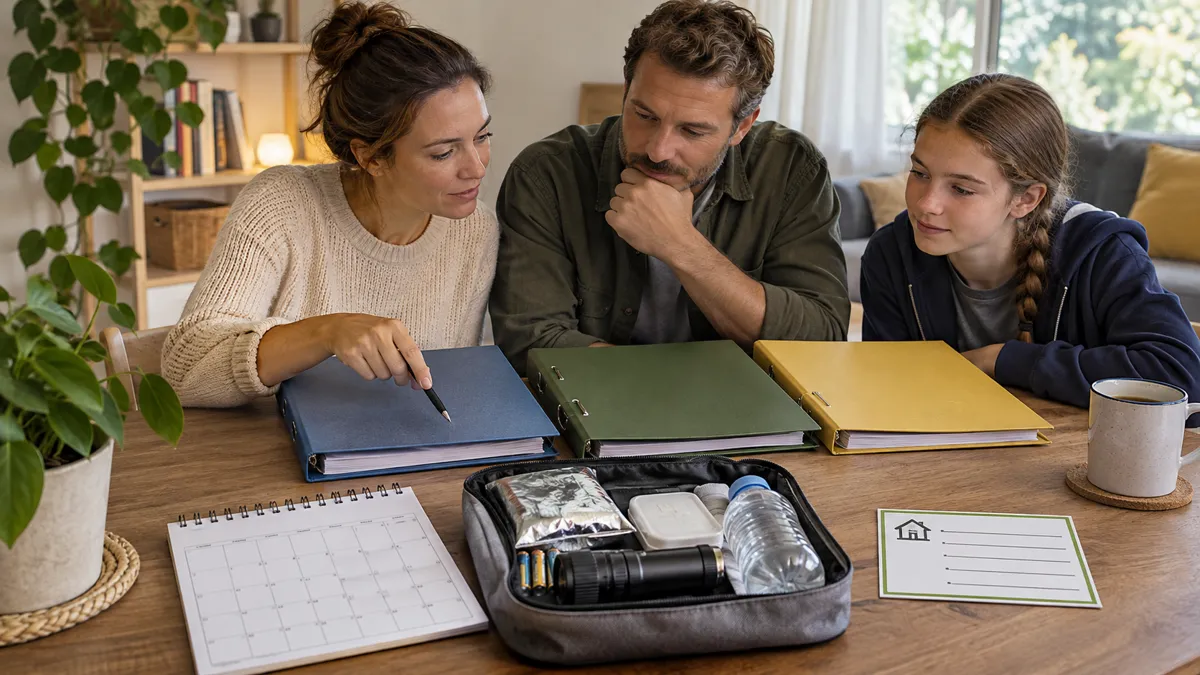
Start with a table exercise: everyone must find a contact, explain a safe outing and name a help they could ask for or offer. Make a list of corrections and assign a workable task to each volunteer.
Two items for putting these ideas into practice
Turn reading into a written action: record a decision, a short list or the next exercise to try.
Affiliate links: as an Amazon Associate, PrépaCivile earns from qualifying purchases. These examples are optional. Check the model, package contents and terms. Use equipment you already own first.
Notebook for household information
Canada: three-pack; France: individual notebook. Compare size and quantity.
Canada — Amazon.ca
 Rite in the Rain Lot de 3 cahiers à spirale résistants aux intempéries, 7,6 x 12,7 cm, couverture noire, motif universel (n° 735-3)View on Amazon.ca
France — Amazon.fr
 Rite in the Rain toutes saisons carnet a spiral , 7,6 x 12,7 cm Étanche NoirView on Amazon.fr
Pen for notes and lists
Check compatibility with your paper and test the pen before relying on it.
Canada — Amazon.ca
 Rite in the Rain Lot de 2 stylos EDC toutes saisons, orange POKKA, encre noire de 0,9 mm, pointe fine (n° OR92), 1 pièce (lot de 2)View on Amazon.ca
France — Amazon.fr
 Rite in the Rain Lot de 2 stylos EDC toutes saisons, orange POKKA, encre noire de 0,8 mm, pointe fine (n° OR92)View on Amazon.fr