
In this article
Finding a way out before you need it is a simple habit of prevention. In a public place, a building or an accommodation facility, find out how to reach a safe place and what solutions exist if your arrival path is no longer usable. This observation must remain adapted to the place and the instructions, without transforming each trip into a search for threats.
Upon arrival, look at the useful indications
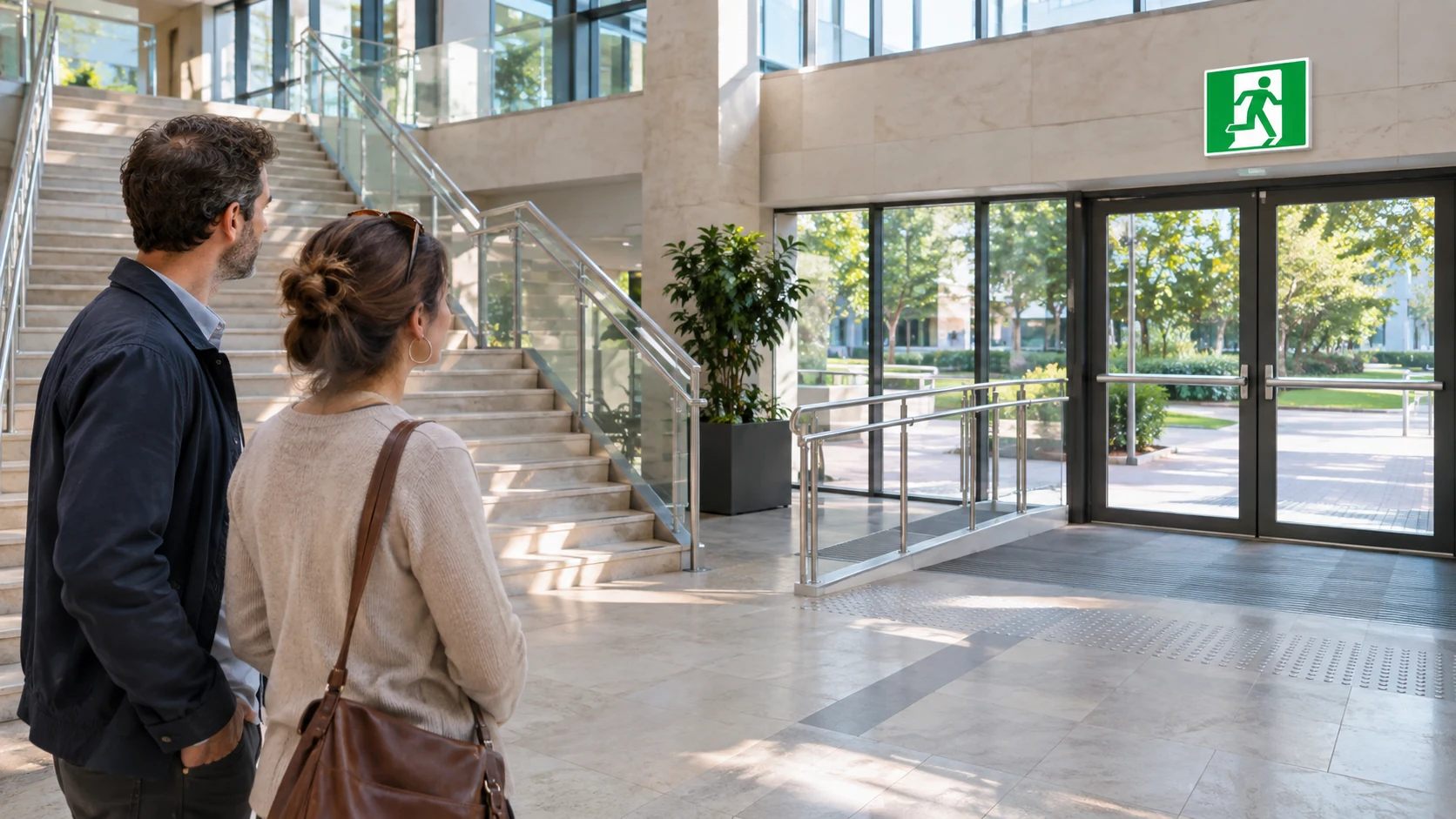
Be aware of the plan displayed when it exists. Locate the identified exits, stairs and assembly point. The closest path may be different from the one you entered. Ask staff if the route or accessibility conditions are unclear.
A window, a roof, a tunnel or a passage through a fence is not automatically a safe way out. Do not plan to cross a forbidden area or descend from a height as an ordinary solution. The building’s signage and procedures provide a more reliable setting than improvisation.
Examine the complete route
A visible door is not enough: where does it lead? The route must be able to be used by the persons concerned. A difference in level, a staircase or a heavy door can change the need for help. Have the provisions for a person who cannot use the staircase specified in advance.
Report a congested exit or anomaly to the person in charge. Do not try an alarm device or a controlled door to train without permission. At home, keep routes clear and make sure occupants understand how to open the intended exits.
Plan another option without imposing a number
There is no universal rule requiring a person to find three paths in any place. The goal is to know what options are really usable and to understand when they stop being usable. A smoky corridor does not become acceptable because it appears on a map.
If an exit is unusable, follow the local procedure and rescue instructions. Avoid looking for an exit by entering a dangerous area. In a house fire, the Quebec government recommends leaving immediately, joining the rally and calling 911, without returning inside.
Moving with others
In a busy place, listen to the instructions of the staff and avoid pushing. Do not turn around to retrieve a bag when the exit movement is engaged. Keep children and people accompanied in the planned organization, without blocking an exit to wait for a forgotten object.
Moving recipes “always diagonally” or “always along a wall” do not guarantee safety in any crowd. Density, obstacles and danger change the possibilities. Prepare an appointment after the exit and a way to report a separation.
Keep marks independent of the phone
A phone can help you view a neighbourhood plan and receive directions. He does not necessarily know the state of an inner exit or a road at the time of the emergency. Do not engage in a closed path because an app continues to display it.
A small lamp can make it easier to move during a breakdown when the trip remains safe. It does not allow to cross smoke or to do without the security lighting of the building.
Exercise: on your next visit to a usual place, locate the signage and ask for clarification on a route that seems ambiguous. At home, practice a safe outing and check the meeting point. A brief observation and an understood procedure are better than a complex scenario never tested.