
In this article
- 1. Fear: between vital signal and psychological inertia
- 1.1. A survival reflex
- 1.2. Perception of risk: between emotion and rationality
- 2. The fear threshold: when the danger becomes tangible
- 2.1. Witte’s model: fear and perceived effectiveness
- 3. Collective fear: contagion, amplification and polarization
- 4. Turning fear into action
- 4.1. Establishing a culture of community preparedness
- 4.2. Psychosocial levers of action
- 5. Concrete examples: when fear makes action
- 5.1. Floods in Quebec (2019-2023))
- 5.2. Winter storms and ice
- 5.3. COVID-19 pandemic
- 6. From fear to resilience: citizen action plan
- Conclusion
- References
- Optional equipment examples
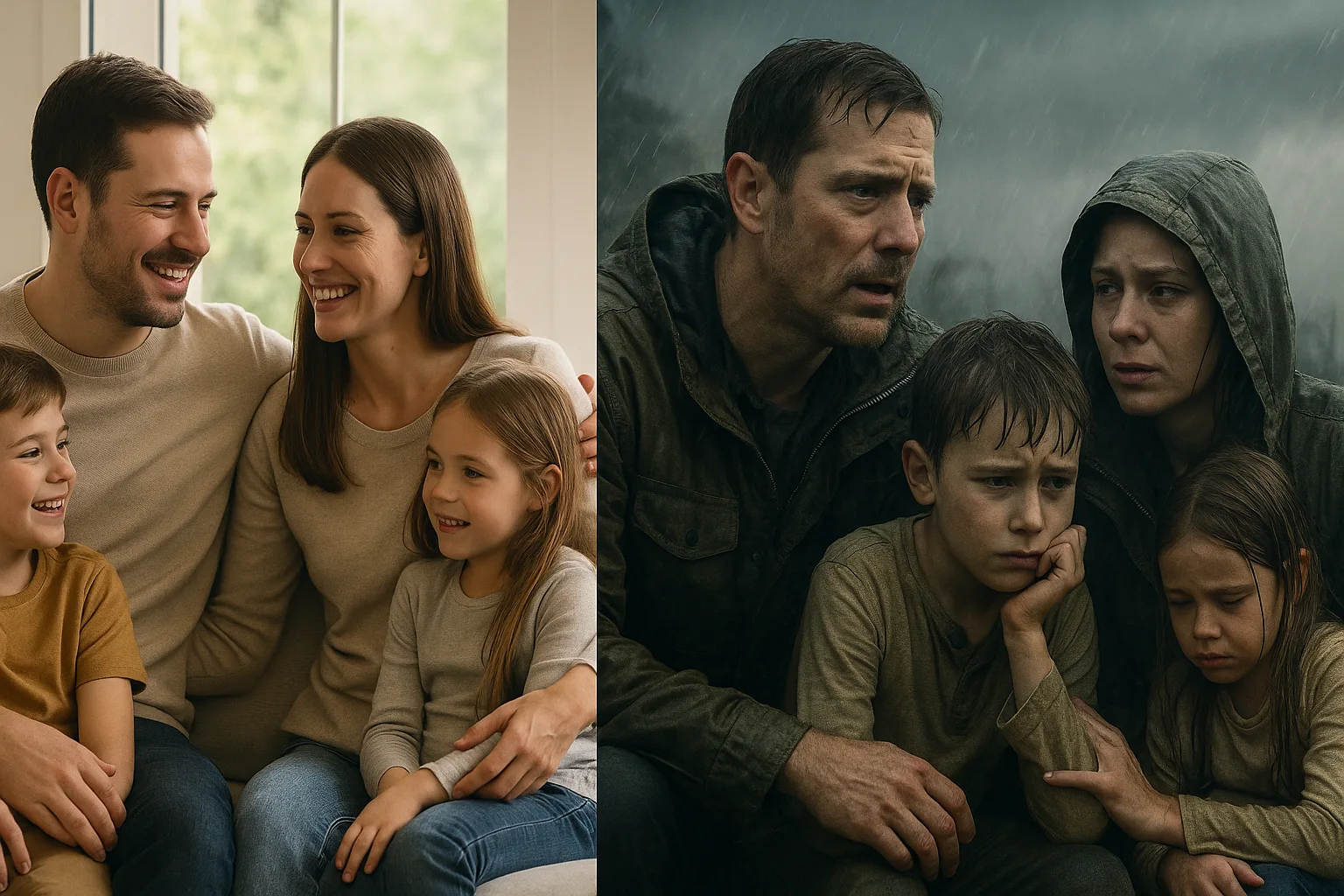
Fear is a paradoxical companion: it can save or paralyze.
When a disaster occurs – whether climatic, technological or natural – reactions of fear, panic or preparedness often appear. after the danger has materialized. Yet, well understood, fear can become a Leverage anticipation, planning and resilience.
In Quebec, the increase in the frequency of floods, wildfires, storms and power outages shows that urgent action is needed. before Fear does not settle.
This article explores the Psychological mechanisms that delay fear, how it spreads collectively, and how to turn it into concrete and citizen action.
1. Fear: between vital signal and psychological inertia
1.1. A survival reflex
Fear is first and foremost an biological mechanism of survival.
It activates the nervous system, releases adrenaline and mobilizes our vigilance. It is an adaptive response that has always allowed us to flee, fight or survive in the face of immediate threats.
But modern disasters are different: they are often progressive, invisible or abstract.
A landslide, a slow flood, a pandemic, prolonged ice - these phenomena do not trigger our internal alarm in time. Result: we Don’t be afraid when you need to..
1.2. Perception of risk: between emotion and rationality
Fear doesn’t just depend on the reality of a danger, but on how we do it. Perceived.
According to Paul Slovic (2015), this perception is largely emotional: we judge a risk according to the feeling it provokes, and not according to its real probability.
Several factors influence this perception. :
-
The immediate emotion (Heuristics of Affect) : If an event evokes frightening images, we overestimate the risk.
-
Personal experience : Those who have experienced a flood or prolonged outage react earlier.
-
The social context : Media, networks and authorities shape the collective perception of danger (Reynolds & Seeger, 2016).
This is in addition to Cognitive bias Well known :
-
Bias of normality : “It won’t happen here.”
-
Illusion of control : “I'll know what to do.”
-
Unrealistic optimism : “The others will be touched before me.”
-
Bias of Availability : We judge the likelihood of a risk based on how easy it is to remember a similar event.
These mechanisms explain why so many citizens Ignore the alerts or are slow to prepare, even when living in high-risk areas.
2. The fear threshold: when the danger becomes tangible
Fear is rarely triggered early.
It emerges when an threshold of perception is crossed - the moment when the threat becomes concrete and visible: an alarm that sounds, a siren, a breakdown, a river overflowing.
This threshold depends on three factors. :
-
the Geographical proximity (The danger “near home””),
-
the Temporal proximity (The Danger of Tomorrow Morning”),
-
and the Emotional proximity (when a known person is affected).
It is at this point that fear ceases to be theoretical and becomes motor.
But this late reaction reduces our scope for action.
2.1. Witte’s model: fear and perceived effectiveness
The Extended Parallel Process Model (EPPM)) (Witte, 1992) explains that fear does not involve action. if the person believes that they can act effectively.
If the threat is deemed serious but the individual feels powerless, he adopts a Mechanism of avoidance (Minimization, denial.
If the threat is credible and accessible solutions, fear becomes a Positive Behavioral Lever.
👉 Clear : Useful fear is the fear that leads to action.
3. Collective fear: contagion, amplification and polarization
Fear is not lived alone; it spreads like a wave, through conversations, networks, images.
This phenomenon, called Social amplification of risk (Del Vicario et al., 2015), manifests itself as soon as a group perceives that a danger is approaching.
-
The media can Amplify the sense of urgency by broadcasting spectacular images.
-
On the other hand, too reassuring messages can Mitigate risk and create false security.
In a crisis situation, this dynamic often leads to a Polarization :
Some deny the danger, others panic. This duality complicates crisis communication and citizen coordination.
4. Turning fear into action
4.1. Establishing a culture of community preparedness
A resilient society is not one that is not afraid, but one that Can use fear to act.
Establishing a Culture of Citizen Preparation It is about normalizing the idea that everyone should prepare in advance: family plan, emergency kit, community communication.
Studies show that a population used to preparing reacts better and recovers faster (Lindsay et al., 2021).
4.2. Psychosocial levers of action
Several variables promote the transition from fear to action (Bandura, 1982; Yang et al., 2025).) :
-
The feeling of personal effectiveness (self-efficacy) : They think their actions matter.
-
Social support : family, friends, community.
-
Past experience : You have already faced a crisis.
-
Clarity of information : Simple, concrete and consistent messages.
Communication approaches based on’Empowerment (empowerment)) are the most effective: they value citizen competence rather than raw fear.
5. Concrete examples: when fear makes action
5.1. Floods in Quebec (2019-2023))
Municipalities that have undergone several successive episodes have seen an improvement in preventive behaviour. Experience has changed the perception of risk and reduced the time to action.
5.2. Winter storms and ice
Every winter, there is a spike in purchases of generators, lamps, radios and supplies. after the first failures - a sign that fear is triggered in contact with reality.
5.3. COVID-19 pandemic
At first, the risk seemed far away. It is only when hospitals have become saturated that fear has generated massive behaviors: reserves, confinement, telework.
The psychological distance suddenly collapsed.
6. From fear to resilience: citizen action plan
Transforming fear into a reflex of anticipation means taking action now. :
-
Identifying local risks : Flood, forest fire, ice, power outage.
-
Evaluate your vulnerabilities : housing, energy, health, technological dependencies.
-
Set up a kit 72 hours adapted to his home.
-
Developing a Family Plan (evacuation, contacts, assembly points).
-
Simulating Scenarios : Practice to reduce stress in real life situations.
-
Strengthen psychological preparation : Learn how to handle uncertainty and stress.
-
Share and train : Raise awareness and participate in local initiatives.
Conclusion
Fear is not a weakness.
It is a Natural Alarm, Emotional intelligence drives us to act.
But without a frame, she becomes panicky.
Our mission, as citizens and as a community, is to make it a driving force. preparation, solidarity and lucidity.
Don’t let fear come from outside: make it an inner reflex.
📘 Download the application PrépaCivile+ Turn fear into preparation.
👉 https://prepacivile.com/app
References
Bandura, A. (1982). Self-efficiency mechanism in human agency. American Psychologist, 37(2), 122-147.
Del Vicario, M., et al. (2015). The spreading of misinformation online. PNAS, 113(3), 554-559.
Lindsay, B., et al. (2021). Community resilience and preparedness culture. International Journal of Disaster Risk Reduction, 59.
Reynolds, B., & Seeger, M. (2016). Crisis and emergency risk communication. Journal of Health Communication, 21(1), 23-28.
Slovic, P., Finucane, M., Peters, E., & MacGregor, D. (2015). The affect heuristic. Risk Analysis, 35(2), 1-13.
Witte, K. (1992). Putting the fear back into fear appeals. Communication Monographs, 59(4), 329-349.
Yang, L., et al. (2025). Resilience, coping and disaster preparedness in households. BMC Public Health, 25, 21361.
Zhou, L., Li, N., & Wu, J. (2020). Disaster experience and household preparedness. Sustainability, 12(21), 9121.
Two items for putting these ideas into practice
Turn reading into a written action: record a decision, a short list or the next exercise to try.
Affiliate links: as an Amazon Associate, PrépaCivile earns from qualifying purchases. These examples are optional. Check the model, package contents and terms. Use equipment you already own first.
Notebook for household information
Canada: three-pack; France: individual notebook. Compare size and quantity.
Canada — Amazon.ca
 Rite in the Rain Lot de 3 cahiers à spirale résistants aux intempéries, 7,6 x 12,7 cm, couverture noire, motif universel (n° 735-3)View on Amazon.ca
France — Amazon.fr
 Rite in the Rain toutes saisons carnet a spiral , 7,6 x 12,7 cm Étanche NoirView on Amazon.fr
Pen for notes and lists
Check compatibility with your paper and test the pen before relying on it.
Canada — Amazon.ca
 Rite in the Rain Lot de 2 stylos EDC toutes saisons, orange POKKA, encre noire de 0,9 mm, pointe fine (n° OR92), 1 pièce (lot de 2)View on Amazon.ca
France — Amazon.fr
 Rite in the Rain Lot de 2 stylos EDC toutes saisons, orange POKKA, encre noire de 0,8 mm, pointe fine (n° OR92)View on Amazon.fr