
In this article
- Understand the problem
- Recipes where baking powder fails the most (field examples))
- Does the baking powder really go out?
- Realistic shelf life
- Simple action vs. double action: why it matters
- The Difference With Baking Soda
- What really works (storage))
- Common mistakes
- Simple substitute when baking powder is missing
- How to test if your baking powder is still effective
- FAQ Express
- Useful products (without over-equipment))
- To read next
- Practical references
- Optional equipment examples
When we think of “food reserves”, we often target rice, legumes, oil or sugar. Still, a discreet ingredient can make the difference when you want to cook with simple basics : the Yeast Chemical. It does not feed on its own, but it makes it possible to transform a flour, a little fat and some ingredients into quick bread, muffins or cakes - in short: a kitchen Functional and Comforting. The concern: she is Very sensitive to humidity and can become ineffective without ever “turning” or smelling bad.
Background: article for planning citizens who want to keep a kitchen functional in times of disruption (breakdowns, unstable supply, isolation, travel). The durations indicated are orders of magnitude : Humidity, heat and container quality make all the difference.
Understand the problem
The baking powder is not “fragile” because it contaminates itself: it is fragile because it rests on a chemical reaction. As long as the components stay dry, everything is fine. But as soon as Humidity between (even a little), the reaction can start slowly… in the container. Over time, this reduces the “power” available. And when it comes time to cook, there is not enough reaction left to make a dough. Typical result: flat bread, dense cake, muffins that do not go up. The most frustrating thing is that it happens often. at the worst time : when you rely on home cooking to stay independent, simple and efficient.
Key Idea : an “old” baking powder is not necessarily dangerous... but it can become useless if it has taken on moisture.
Recipes where baking powder fails the most (field examples))
We rarely discover a “tired” yeast in a complicated recipe. We discover it in recipes Simple — the ones we do precisely when we want to go fast, limit the ingredients and avoid waste.
Fast bread
Express bread / Pan bread / soda bread Here, the baking powder is often the only rising agent. If it is weakened : Flat Bread, dense crumb, impression of humidity in the center.
Failure remains “invisible” until baking → avoidable waste.
Muffins / cakes
Fruit muffins / natural cake / cake Lifting must be fast and homogeneous: otherwise, texture Compact, heavy center, sometimes pasty, even if the taste remains correct.
The classic sign: “it doesn’t go up” despite a usual recipe.
Pancakes / scones
Thick pancakes / scones / biscuits Failure is sometimes subtle: it “works”, but the texture becomes heavy and the sensation in the mouth is more dense.
It’s often the recipe you want to succeed with the first shot.
Practical reflection : If a recipe you usually succeed suddenly fails, and your flour/eggs are OK, the first suspect is often baking powder (humidity, heat, frequent openings).
Does the baking powder really go out?
- It doesn’t usually become dangerous. : It’s not the same as a fresh product.
- It can become ineffective : Moisture (and sometimes heat) reduces its effectiveness, even if the smell and appearance seem normal.
To remember: an “old” baking powder is rarely a health problem... but it can become useless if it has taken on moisture.
Realistic shelf life
The printed date is a landmark... but the true duration depends mainly on the humidity and the number of openings. Here is a realistic estimate for the majority of households.
Closed
Closed packaging : use the date and manufacturer's recommendations. Dry storage limits the loss of efficiency, without allowing to promise several more years.
The real enemy: humidity + heat.
Open
Open packaging : note the opening date, close carefully and follow the product instructions. A test before an important recipe helps to spot a loss of activity.
The more you open, the more moisture will come in.
Simple advice : If you rarely cook, choose small formats or make a Container of Use + Sealed Reserve. This is a simple method to keep reliability without overstocking.
Simple action vs. double action: why it matters
Many modern baking powders are “Double Action” : they react once in contact with moisture, then a second time in the heat in the oven. This improves regularity... but does not make the yeast immune to moisture.
- Simple action : reacts mainly during mixing (moisture) → waiting too long reduces the effect.
- Double action : reacts partly during mixing and partly in the oven → more forgiving, but still sensitive to damp storage.
Reflex : whatever the version, keep it dry and Test If you have any doubt.
The Difference With Baking Soda
Many confuse the two. They are close... but not interchangeable “blindly”.
- Baking soda : very stable in storage; it needs a acid (lemon, vinegar, yogurt, buttermilk, molasses, natural cocoa, etc.) to produce the gas that causes it to rise.
- Baking powder : already contains a base + acid(s) + anti-moisture agent; minimal humidity can trigger a premature reaction.
In preparation : bicarbonate is often more “reliable” to storage... provided you know how to activate it properly (with an acid).
What really works (storage))
Here, the goal is not perfection. The goal is the Reliability. A few simple gestures give better results than poorly applied “technical” solutions.
- Store dry and cool : stable closet, away from the stove, away from the steam.
- Limiting the openings : small container of use + sealed reserve (simple rotation).
- Hermetic : After opening, repack if the original packaging closes incorrectly.
- Label : opening date + “test” date (e.g. in 6 months) to avoid surprise.
Option 1
Original packaging (if reliable)) Keep closed, dry, in a secondary airtight box (moisture barrier).
Option 2
Hermetic jar (common use)) Ideal if you cook often. Objective: limit moisture and unnecessary openings.
Option 3
Long-term reconditioning Sealed barrier bags (type Mylar), stored cool and dry. Ideally done in dry weather.
To be avoided
Steam/heat (above the oven), improperly closed containers, large volume permanently open.
Council “Field”” : If you repackage a reserve, do it. in dry weather (or with a dehumidifier running). Timing at the time of bagging is often worth more than the improperly used “best container”.
Common mistakes
Mistake No. 1: store near a heat or steam source (oven, kettle, dishwasher).
Mistake No. 2: constantly open/close a large format (humidity eventually enters).
Mistake No. 3: never test (we discover the failure at the time of the cake).
Error n degrees 4 : believe that “vacuuming” equals perfect barrier to moisture over several years (not always).
Simple substitute when baking powder is missing
Troubleshooting substitution for 1 teaspoon of baking powder : the formula published by King Arthur Baking combines ¼ teaspoon of baking soda, ½ teaspoon of cream of tartar and ¼ teaspoon of cornstarch or tapioca starch. Use an appropriate recipe; the result does not necessarily replicate double-acting baking powder.
Good reflex : bicarbonate alone can give a “soapy” taste if the acid is missing. If you substitute, make sure an acid is present.
How to test if your baking powder is still effective
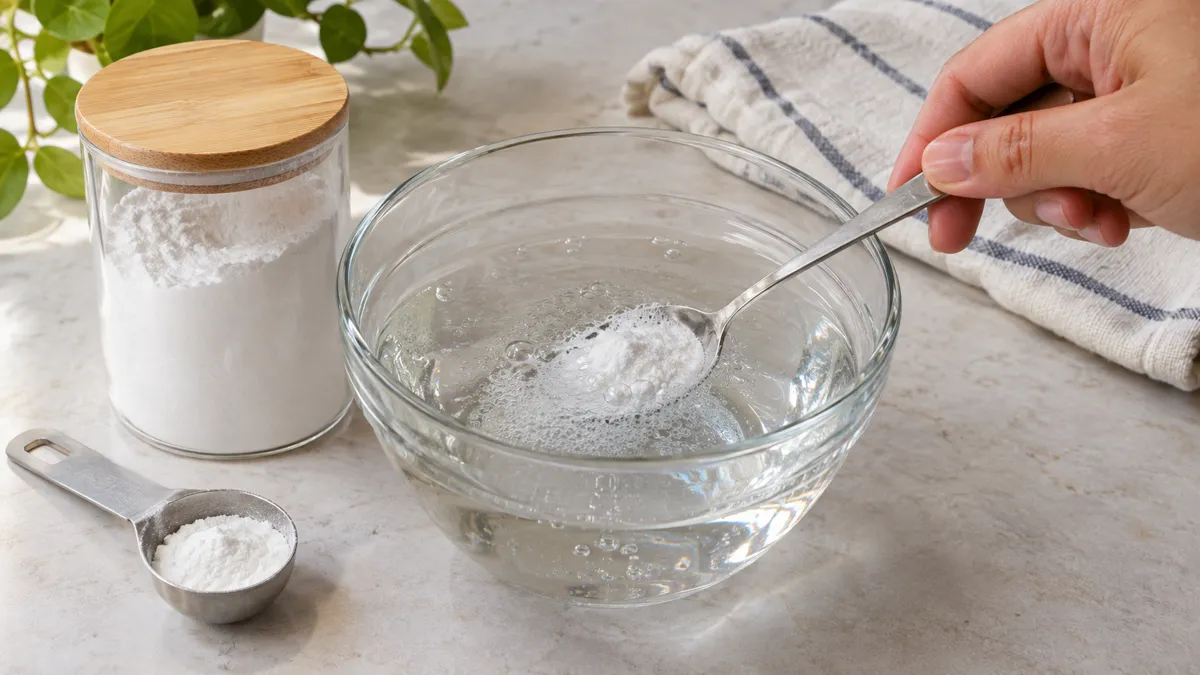
Before an important recipe (or in the context of limited resources), test in 30 seconds :
- Place two tablespoons of warm water in a small bowl.
- Add 1/2 teaspoons of baking powder.
- Watch : Net bubbles equal to efficient; weak or absent bubbles equal to very diminished efficiency.
A weak reaction justifies replacing the powder for a recipe that must succeed. Do not arbitrarily increase the dose: this changes the taste and composition without guaranteeing lift.
FAQ Express
Can I freeze the baking powder?
This is not necessary for most homes. The most important remains le sec. If you freeze, avoid the exit/entry (condensation) cycles. Let return to temperature in a closed container.
Why is my cake dense even if the yeast is not “perished”?
The date is a clue, not a guarantee. Humidity, heat and frequency of opening are often the real causes. The hot water test remains the most reliable verdict.
Bicarbonate + vinegar: is it equivalent to baking powder?
It works in several recipes, but it is not always the same (texture, timing, acidity). The simplest: test a “non-critical” recipe before counting on it in a real situation.
What is the best way to avoid unpleasant surprises?
Fractioner : Small container of use + Sealed Reserve, and note the opening date. Then do a quick test before an important recipe.
Useful products (without over-equipment))
- Baking soda : very stable to storage and versatile.
- Small airtight containers : use + sealed reserve.
- Barrier bags + sealing : if you want to recondition a reserve in a more sustainable way.
To read next
Practical references
The water test measures a lifting activity, not the safety of a wet, soiled or poorly identified product.
- King Arthur Baking - differences and substitutions.
- King Arthur Baking - check the activity of the leavening agents.
Two items for putting these ideas into practice
Identify containers, date batches and record food-storage conditions.
Affiliate links: as an Amazon Associate, PrépaCivile earns from qualifying purchases. These examples are optional. Check the model, package contents and terms. Use equipment you already own first.
Containers for organizing dry foods
Canada: 7.8-cup container; France: four-piece set. The offers differ in capacity and contents. Follow the stated food-storage uses.
Canada — Amazon.ca
 Contenant Rubbermaid, plastique sans BPA, Brilliance Pantry stockage hermétique des aliments, stock ouvert, cassonade (7,8 tasses)View on Amazon.ca
France — Amazon.fr
 Rubbermaid Brilliance Lot de 4 boîtes de conservation alimentaire sans BPA avec couvercles, hermétiques, résistantes aux taches, passent au lave-vaisselle, grisView on Amazon.fr
Notebook for household information
Canada: three-pack; France: individual notebook. Compare size and quantity.
Canada — Amazon.ca
 Rite in the Rain Lot de 3 cahiers à spirale résistants aux intempéries, 7,6 x 12,7 cm, couverture noire, motif universel (n° 735-3)View on Amazon.ca
France — Amazon.fr
 Rite in the Rain toutes saisons carnet a spiral , 7,6 x 12,7 cm Étanche NoirView on Amazon.fr