
In this article
Distinguish between the vessel’s general alarm and the decision to abandon, and then follow the ship’s own procedures.
Before you navigate
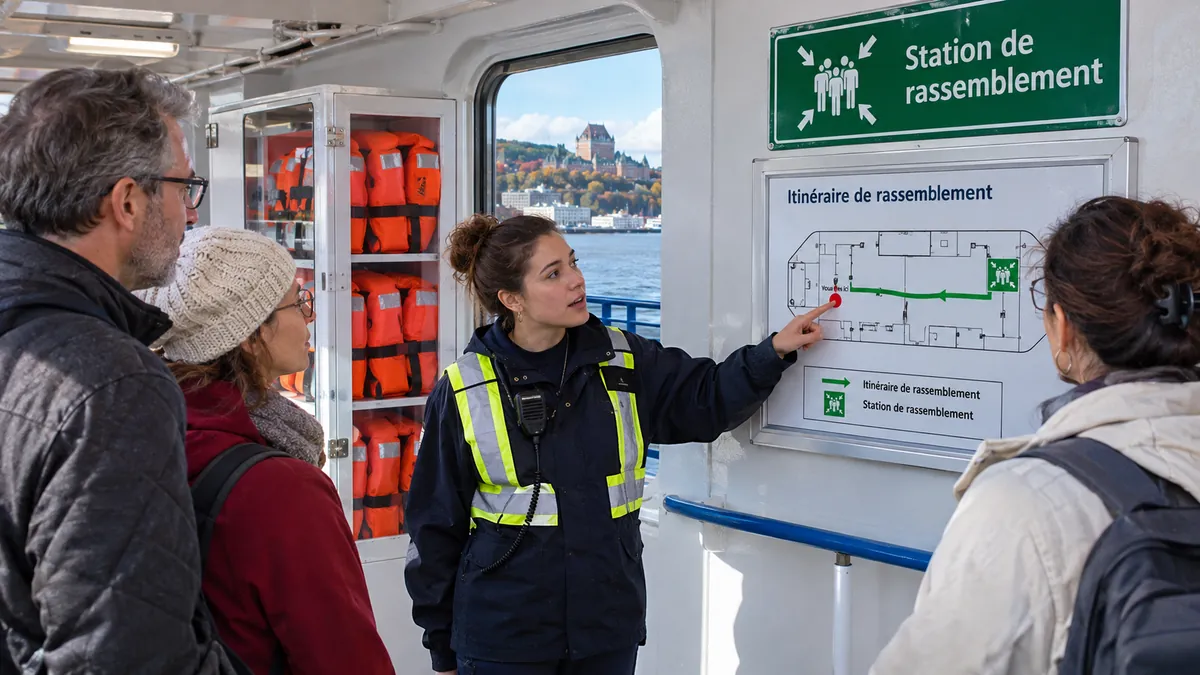
When boarding, read the instructions and equipment. Identify the assembly station that’s right for you, access routes, and how to get help. Locations vary by ship.
Participate in the explanations and exercises requested. If information is not clear, ask the crew. A short crossing does not make these landmarks useless.
Understand the signals
The general marine emergency signal consists of seven or more short signals followed by a long signal. He calls the planned actions and the gathering according to the instructions of the ship. This is not, in itself, an order of abandonment.
Abandonment is arranged under the authority of the captain and crew. Listen to announcements and follow the signs for vests, clothing and boats. Do not improvise a jump or a launch.
Join the indicated position
Take the reported routes and follow the staff. Do not take an elevator or pick up a suitcase. Do not block passages. An exit that seems closer may lead to an affected area.
Inform the crew of a missing person and their last known location rather than re-searching for them in a dangerous area. Also report any difficulty moving or discomfort.
Children and special needs
Check the appropriate size equipment and assistance modalities with the edge. Keep the children with the adult in charge of accompanying them and explain simple instructions.
People who need assistance should be able to report this before and during the incident. Do not assume that another passenger knows a safe method of transport or transfer. The procedures must be adapted to the equipment and the ship.
Emergency boating or immersion
Follow the instructions for boarding, dispatching and use of the equipment. Do not detach a raft or boat on your own. Decisions depend on the dangers of the moment.
In cold water, breathing and movement can be quickly affected. Use flotation and follow the rescuers. Do not present swimming to a theoretical hypothermia rib or duration as a general solution.
What to remember
Useful landmarks are simple: know the instructions, reach the indicated station, ask for the necessary help and follow the crew. No record of shipwreck can predict the time available on another ship.
After the incident, follow the instructions of the authorities and report the need for care. The return to the spaces or personal effects awaits the appropriate authorization.
Sources and Updates
Documentary verification: November 3, 2026.
- Transport Canada – Evacuation and Passenger Safety
- IMO - standard phrases, general alarm and assemblyOriginal PDF · source language preserved
- Transport Canada - Vests and Cold Water
Two items for putting these ideas into practice
Check portable lighting and accessible drinking water for travel or departure.
Affiliate links: as an Amazon Associate, PrépaCivile earns from qualifying purchases. These examples are optional. Check the model, package contents and terms. Use equipment you already own first.
Headlamp for hands-free lighting
Check required batteries and storage; supervise children using the light.
Canada — Amazon.ca
 BLACK DIAMOND Spot 400 Lampe frontale | Luminosité de 400 lumens | Intensité variable | Étanche et durable | Fonctionne avec 3 piles AAA (incluses) | GraphiteView on Amazon.ca
 Black Diamond Unisex Spot 400 Lampe Frontale Graphites One Size
Bottle for carrying drinking water
Listed capacities differ: approximately 946 ml in Canada and 1 L in France. A bottle does not make contaminated water safe.
Canada — Amazon.ca
 Nalgene Bouteille d'eau à large goulot de 946,2 ml, sans BPA, durable et anti-fuite, légère pour randonnée et salle de sport, travail et voyage, bleu céruléenView on Amazon.ca
 Nalgene Gourde 'WH Sustain' Azuré 1 L